Third-person Driving

April 28, 2011

Sofia Coppola seems to make movies that have a high tendency to ignore the most basic traditional film grammar, which often results in boring and futile scenes thorough the movies. Lost in Translation was watchable and semi-interesting intercultural study, but Coppola’s newest flick, Somewhere, was just a little more than an empty shell of a feature film. Perhaps I’m just too old and not hip enough to enjoy of watching 1,5 hours Stephen Dorff driving around with a Ferrari, watching twin strippers to pole dance, playing Guitar Hero, and chatting nonsensical small talk with his on-screen daughter.

There was, however, one specific scene that caught my eye immediately, in which the camera follows from behind as the protagonist drives uneventfully his car into a highway. Of course, this kind of weird and meaningless scene was intended to contribute to the mystique of Coppola’s craft, but it was also a testament for how recognizable that particular way of portraying a moving vehicle actually is when considering the realm of video games.
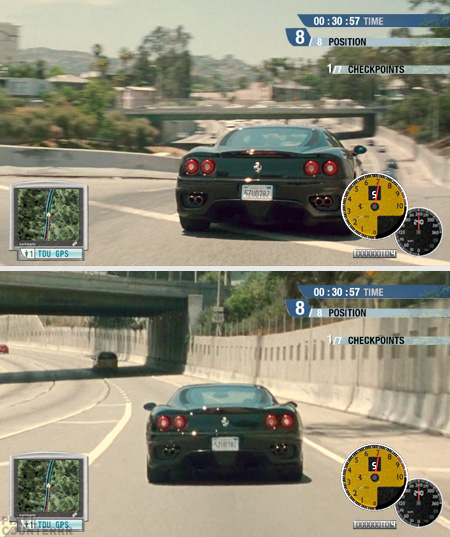
Indeed, I couldn’t help but seeing the scene as something taken from a modern driving game, and it makes one wonder if the prevalence of video games did have an effect on Coppola’s vision, at least at an unconscious level. And when I slapped some HUD elements from Test Drive Unlimited on top of the (cropped and adjusted) imagery from the movie, the resemblance became uncanny.

I believe it was Pole Position back in 1982 that really established the “rear-view” paradigm for driving games, although the original OutRun (1986) must be the most iconic case in point by far. Interestingly, back then the rear-view was employed partly due to technological limitations, as the camera couldn’t rotate along the y-axis, so they ended up rotating the car on the screen instead. Now, in the age of fully simulated space, the chase view is obviously nothing but an artistic decision (or an index of laziness to make a decent cockpit.)

Yo Taxi!

April 22, 2011

The reason why I write so much about Grand Theft Auto IV is that Rockstar Games simply did so many things right with it. Rockstar knows we don’t need space marines, fantastic creatures, or apocalyptic scenarios to create interesting make-believe experiences.  All we need is quality simulations of common, recognizable situations that a player can handle with uncommon ways, if he or she so chooses. And that’s really the charm of video games and simulations at large: the What If scenarios.

What if instead of jogging in Central Park, I drive through it with a stolen police car, shooting hysterically around out of the window? Or what if I use a motorcycle to jump on the roof of a subway car, while it’s passing under the overpass? YouTube is filled with different kinds of GTA IV trick videos, which is telling how versatile and deep the GTA IV’s sandbox really is.

Then again, experiencing the most mundane operations in a credible virtual setting can be equally fun, if not more. It’s almost comical to admit that one of the most mind-blowing aspects of GTA IV for me was the way taxi trips were conducted. The fact alone that you could now take a taxi to places and not just hijack one was a brilliant, though obvious, idea from Rockstar.

First off, taxicabs in GTA IV serve as a conduit for fast traveling conveniently around the map, which didn’t feel as much cheating as in, say, Fallout 3, in which one just pointed and clicked the location on the map.

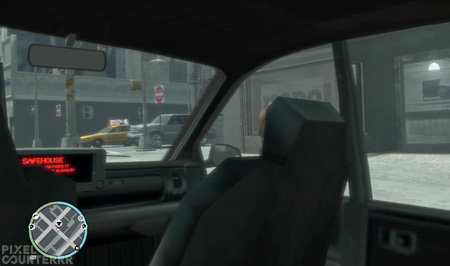
But secondly, and much more importantly, the player could choose not to fast travel and thus sit through the whole trip in the backseat enjoying the scenery from a first-person view. And this was in my mind the coolest singular concept that Rockstar came up with the game (besides implementing the Euphoria physics engine).

So, when entering a taxi, the game basically transforms into a completely different experience. It becomes like a theme park ride that showcases GTA IV’s technology up close, proving, in effect, that the engine performs pretty well from a first-person view as well. Furthermore, it forces (not really since you can skip the trips) you to just calmly observe the simulated environment, instead of messing around with it. Rockstar is undoubtedly proud what they did with the world, as it should.

Of course, video games at large are filled with similar on-rail sections that put constraints on player’s movement, but GTA IV’s taxi rides differ drastically from those: The rides are different every time you take one. And you know it, so “anything” can happen (and you can’t do anything about it!).

The real charm of riding a cab for me is indeed that womb-like confined space from which you observe the outside world, seemingly safe from the harms of it. It really feels like you have let someone else to take control of your destiny, and all you can do is to try to enjoy the ride (or skip it by pressing a button).

The taxi rides in GTA IV prove the fact that we generally feel emotions through identification, be it during watching movies, reading books, or playing video games. And, like said, the more familiar and thus identifiable the make-believe situations are, the bigger the emotional impact usually is.

It seems that Rockstar gets this like no other developer in the industry.

Extra Medium

April 6, 2011

When talking about the concept of simulation, we are always dealing with a highly idealized model of reality – otherwise, it wouldn’t be a simulation. Simply put, the logic of how the reality behaves as a whole is just far too convoluted to be fully understood, and as a result, fully replicated in a model. Simulation is, by definition, an inferior (i.e. simpler, cheaper, more practical) construction of its original referent, and as such, an instrument for experimentation and play. But the most importantly, for play.

So even the most advanced scientific simulations today fall short of replicating the reality as it is, and commercial simulations like video games must compromise the modeling even further. Of course, we have come a long way from abstract Lego-sized pixels to relatively credible visual depictions, but the gap between reality and simulation is there – and always will be. The question is, to what extent we notice that gap, and what can we do about it?

On that note, I remember back in 1996 sometimes putting Grand Prix 2 to the replay mode and then squinting my eyes so that the vision blurred enough to make the imagery look more or less photorealistic. I did acknowledged the stupidity of that exercise, but it made me realize nevertheless that convincing “synthetic realism” in real-time was indeed possible, even if one had to alter one’s perception to achieve that.

This is the reason why I find sometimes off-screen YouTube gameplay footages fascinating, since the camera (especially when shaky) adds in a way an extra layer of realness to the imagery that may be otherwise too crisp and sterile. And furthermore, the 60 fps footage produces a cool motion blur-like effect when filmed in 30 fps or lower.

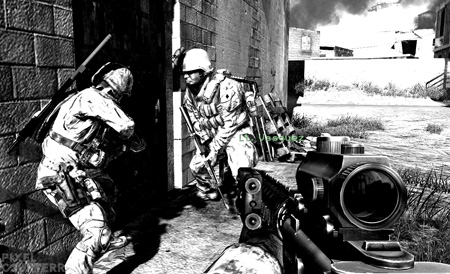
So even though I generally dislike over the top post-processing effects, sometimes they can create interesting results for the reasons presented above. For instance, in Call of Duty 4: Modern Warfare the player can turn on in the cheats menu certain post-processing effects that render the game to look like over-saturated black&white photography, consequently decreasing the gap between simulation and reality to some degree.

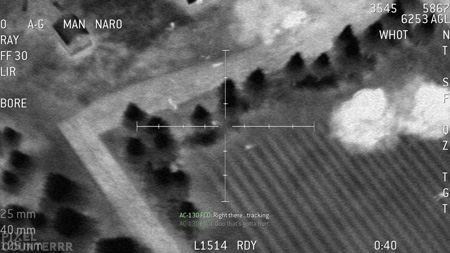
And who could forget the notorious Death From Above scene from the same game, of which “thermal imagining” was almost indistinguishable from the real thing. The realness of the scene were very much due to the heavy noise and ghosting effects that masked the deficiencies inherent to real-time imagery, and thus, made it appear more real.

It seems that an additional medium on top of the real-time imagery can really push the (photo) realism further, at least to a certain extent. I’m not sure if the whole game should be carried out this way – it could get exhaustive fast (see Kane & Lynch 2: Dog Days) –, but like Death From Above scene proved, highly “mediumized” real-time imagery can work really well in small doses.

At the end of the day, I believe the Death From Above scene did have the deepest impact on most of us in terms of Call of Duty games at large simply because it just looked so real. And even without the need to squint one’s eyes.

Passing By

April 2, 2011

The original Test Drive developed by Distinctive Software was my first introduction to something I call first-person driving. Of course, the game is rudimentary at best judged by today’s standards, but it popularized a number of game play elements that we now take for given, such as a roster of differently handling civil cars, police chases, manual shifting, and so on.

TD was not indeed only an inevitable reaction to the so-called yuppie culture that dominated the early 80s, but also an ideological ground zero for, for instance, Need for Speed –series that is easily the most important intellectual property for simulated driving at the moment. TD proved that racing doesn’t have to take place in a dedicated track and that it can be actually more fun and intense outside one. Just like in real life.

It comes as no surprise that in TD, considering it was released in 1987 for home computers, the simulation of depth was carried out with jumpy sprites. The biggest problem when using sprites to depict 3D space is of course their complete lack of depth, so cars, traffic signs, and so on are nothing but cardboard cutouts of their real life counterparts.

To be fair, sprites in TD worked generally fine in the distance, but the “closer” they got, the flatter they obviously appeared. And when overtaking another vehicle, the fragile illusion of three-dimensional objects broke down completely.

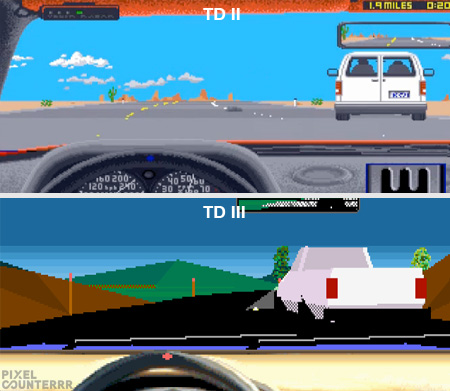
TDs sequel, The Duel: Test Drive II released two years later, kept the graphics paradigm basically intact, but in 1990 Test Drive III: the Passion finally entered the realm of (jumpy) polygon-based imagery.

Sure, the graphics engine of TD III was a bit of a mess and as a game almost unplayable, but one thing that struck me heavily back then was the pure idea that now you could actually see the side of a car when driving past it without the illusion disintegrating. And it didn’t bother me one bit that the polygon cars were in some ways much less detailed and more abstract than the sprite ones. No, that was beside the point. The point was real, genuine depth of objects no matter the visual cost, which was, of course, substantial back then.

I have always found it extremely interesting whenever a certain visual concept is translated into a different graphics principle. The thing is, when immigrating from sprite-based imagery into polygon based such (or the other way around) more often than not the viewing paradigm shifts drastically in the process. Think about for instance Super Mario World and Super Mario 64, how they both depict the make-believe reality in two completely different ways.

That said, what ultimately made the jump from TD (or in fact TD II) to TD III fascinating was the fact that the fundamental viewing paradigm (first-person) was the same in both instalments, even though the underlying technology wasn’t. It was like the developer was forced to admit that the original sprite-based solution was indeed all smoke and mirrors, and now with TD III they were actually serious about it, first-person driving that is.

Till Death Do Us Part

March 22, 2011

Death: the ultimate frontier. No other medium than video games has ever been so fixated with the concept of death, and at the same time, been so nonchalant towards it. As a result, I’m pretty sure that the amount of bodies produced by player in a single Call of Duty –game can beat the bodycounts of every movie ever made by Arnold Schwarzenegger, Sylverster Stallone, and Chuck Norris put together. To kill a man in a game isn’t just that big of a deal as it shouldn’t be.

Indeed, spontaneous screams like “I DIED!” and “I KILLED YOU!” have companied gaming from the very beginning, and terms like “lives” and “an extra-life” were an integral part of the gaming vocabulary until save-systems made them obsolete.

The oldest cliché would be now to wonder what it reveals about the Human Condition that the gaming culture (the only medium that lets people do stuff) is so soaked with death, violence, and destruction. However, I’ll pass that opportunity for now.

Can death, then, be an aesthetic experience? I doubt it.

How about a simulated death? Sure.

A case in point is the way Grand Theft AUTO IV handles death of the protagonist.

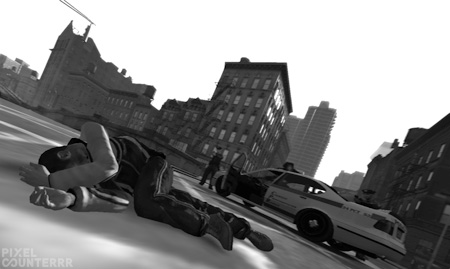
First, there are two art direction decisions that take effect when Niko gives up the ghost: High-contrast black&white imagery and slow motion. To desaturate an image of deceased is of course a common practice, and it indeed is an effective strategy to suck out life of any imagery. And slow motion as well can be considered a rather classic approach to create ad hoc dramatic feel to a scene.

Of course, in the case of GTA IV, black&white imagery and slow motion would be futile without the sophisticated physics engine the game utilizes, Euphoria, which simulates the physics of a human corpus like no other engine in existence. In comparison to other physics engines, Euphoria makes for instance a clear distinction between how a lifeless body and a living one absorb hits, so when Niko goes belly up, the ragdoll system that kicks in truly makes him look like an empty shell of a man hitting slowly the curb. And when cops keep on shooting the dead, wiggling body on the ground you almost feel sorry for the guy, which is said a lot about a video game.

Interestingly, slow motion at large seems to be the opus moderandi for aestheticizing physical causal chains in general – actual and simulated ones. Just think about The Matrix and all its slow motion scenes with ultra-slow explosions and flying debris. They looked cool then, and they look cool now.

And speaking of causal chains, what usually fascinates me the most in player’s death in GTA IV is indeed the aftermath that often follows the fatal incident: A dropped gun fires itself, cars explode, people get run over, and so on. And you can only watch it from aside without any control over the events, until the screen fades black and everything starts over.

This all must make me sound a bit of a sadist, but believe me, I’m the least eager to watch any real violence whatsoever. I just happen to find beauty in simulation, be it of the workings of a whole city, or just of a guy passing by on the other side.

Polygonhawk

March 12, 2011

The reality is, to come across aesthetics generally associated with polygon-based imagery outside the digital domain can be considered a somewhat rare occurrence, most likely due to the distinctive fundamentals and principles the medium is based on.

But it does happen.

One of my favorite cases of such are sculptures made of archival card and foamcore by Susy Oliveira, in which an aesthetic principle basically jumps off from the computer screen into the tangible reality, in a quite elegant manner.

So, as we noticed in the previous discussion, there are indeed times when reality uncannily imitates art and not the other way around. And to be more precise, computer-generated such. Furthermore, in addition to the case of NASCAR headlights echoing old-school texture-mapping, I made a brief remark about a fighter plane known as F-117A Nighthawk, implying how it resembled to an extent of something made out of polygons, and relatively a few of them.

I do acknowledge that a visual appearance such as of a stealth fighter is designed for various, non-aesthetical reasons, like aerodynamics and more importantly, to deflect radar signals. Even so, I find it extremely fascinating when aesthetics found in the physical reality collides with of the virtual world, like it does in this mysterious, pointy plane.

Better yet, as said in the NASCAR post, where things get really interesting is when this kind of “mimetic art” (if you can say so about a military vehicle) is in a way brought back to its original, aesthetic environment. As one can notice from the above Nighthawk model extracted from Tom Clancy’s H.A.W.X., the polygon-mesh isn’t just an estimation of the surface of the plane, it is the surface.

Obviously, there’s a myriad of real world shapes with similarly minimal geometrical properties, and thus equally analog to low-poly imagery. Examples that come to my mind are certain buildings, designer furniture, home electronics, and so on. But what then made Nighthawk so special in my mind must have been the context, as fighter planes at large tend to be more complex in terms of overall geometry.

Indeed, when comparing the model of Nighthawk to other select aircrafts found in TC’s H.A.W.X., the Nighthawk’s polycount was noticeably lower than the average, and thus substantially more “polygoney”. Sure, F-22 Raptor came close too, as it bears similar stealth design, but in my mind, Nighthawk is still a premium example of what I’m trying to convey here. Additionally, the difference would probably have been even more dramatic if I had compared only the fuselages of the planes, since a chunk of the polygons go to the landing gears and other minor detail.

All this actually makes me think of the famous Death From Above –scene in Call of Duty 4: Modern Warfare, which could be seen as a video game mimicking a weapon mimicking a video game, and I believe the whole point of that scene was exactly to emphasize that absurdity.

Artifacts and Art

March 1, 2011

As we all know, when operating within a certain medium, there are in some cases these (usually unwanted) medium-specific byproducts being generated, popularly referred to as artifacts. Regarding visual arts, artifacts can take a form of distinct glitches on the screen, like a certain type of static or noise, but also – at least in my mind – an overall look that brings forth and in a way reveals the technological deficiency of given medium to handle certain aspects of the imagery.

So, when looking back at the history of technically produced imagery, it’s interesting to notice that it seems to be only a matter of time when artifacts connected to visual fidelity leave the unwanted section, and enter the realm of art direction. Features that at first were considered undesirable “dirt” and an eyesore have turned from time and time again into means for hip and cool in the hands of avantgardists.

Indeed, just like the crackling sound of vinyl bears an unquestionable aesthetic dimension in the modern music-producing scene, there’s a host of visual artifacts that artists tend to use today either ironically and self-awarely, or as an artistic statement, instead of out of technological limitations. Black and white photography must be the most popular (and obvious) case of such a practice that employs arbitrary limitations to attain a certain look and feel, which makes me wonder who was the first one to use black and white imagery by design, and not because he or she had to?

What comes, then, to real-time imagery, the use of visual artifacts is a fairly recent invention, perhaps due to the highly technological nature of the medium. The fact is, real-time graphics has through its existence battled with technical limitations like no other medium in the history, and what’s crucial to address here is that an artifact (i.e. a manifestation of technical limitation) to become a brush for art direction, must involve such a technical problem that’s already been solved to a degree. That’s the reason why, for instance, low frame-rate hasn’t been used so much as an artistic effect, since high and steady frame-rates are still an ongoing struggle within the real-time medium, and as such, an endeavour far from concluded.

As said, the use of oversized pixels (see above Super Soviet Missile Mastar by The Behemoth 2011) made artistically sense only after when screen resolutions in general seized to be so much of an issue anymore. The same goes for now relatively popular low-poly art, since polycount (just like screen resolution) hasn’t really been a major technical constrain for a while. Interestingly, low-poly aesthetic is now being used even outside the real-time context, like in the animations by David OReilly.

Yet another interesting use of artifacts is Jörg M. Colberg’s pieces that utilize heavy but controlled JPEG compression as an aesthetic element. Naturally, the art pieces wouldn’t have had nearly the same impact back in the day when JPEG artifacts were a real problem when compressing images to a reasonable size.

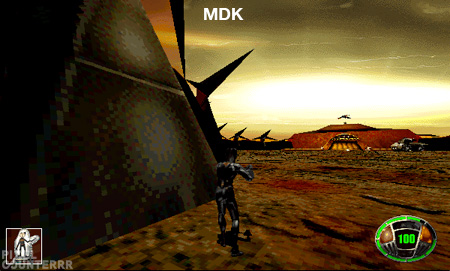
This all makes one think what other technological artifacts there are yet to be employed in an artistic/ironic sense? For instance, it’s interesting to see if rasterized textures, as seen in the late 90s games like MDK (Shiny 1997), with a relatively low color depth will at some point become a stylistic choice for video games and animations. Logically it indeed could be the case somewhere down the line, but we’ll see about that.