Scary Good Lighting

September 3, 2011

From time to time a game comes along that simply radiates unconditional love, technical understanding, and pure commitment towards the craft and the medium in a way that borderlines magic, for the lack of a better word. For me, the first Dead Space by Visceral Games was one of those titles and the sequel Dead Space 2, released three years later, pushes even further the brilliance of the first one, at least technology-wise.

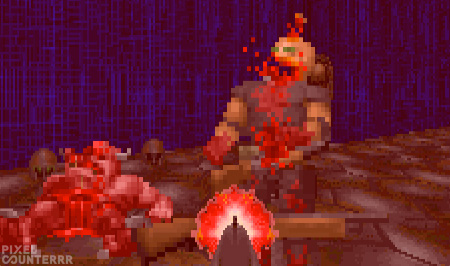
If a survival horror game, which Dead Space games very much are, lives or dies by something, it’s the way it handles the lighting. It was indeed the lighting and the semi-dynamic nature of it that made, for instance, the original Doom so effective at the time. Without it, we wouldn’t reminisce Doom the half we do now, that’s for sure.

So, paradoxically, it takes credible lighting to convey credible darkness. And it’s the inherent fear of the dark in all of us that renders darkness so useful and integral to fear-inducing settings: We need to see our surroundings in order to survive, and we fear more than anything our own demise. It’s as primal as that.

Luckily, of all the cool aspects and details both Dead Space games share, above all is the overall lighting scheme, which is simply put excellent. Yes, Dead Space games don’t include any sophisticated real-time radiosity or ambient occlusion solutions, but the point is Dead Space games do the basic stuff exceedingly well with solid technology and proper art direction.

What strikes me the most about the lighting is the degree at which the player can interact with it, meaning almost every light source that looks moveable is indeed moveable. It really is amazing to pick up, for instance, a light emitting flashlight from the scenery that would be in all probability a static object in some other game. In fact, I barely believed my eyes when I did so at the first time and saw how the flashlight kept illuminating and casting well-defined shadows onto the environment, even if it was only a random prop laying around. It’s exactly this kind of attention to detail and consistency that raise a game above the mediocrity.

Then there are lens flares, especially in Dead Space 2, that make one’s eyes water out of pure visual enjoyment. Lens flares can be a distraction when done wrong, but Dead Space 2 pretty much nails the use of them. There are number of nice little touches everywhere in the game, such as the delicate light-streak on the front of the helmet that is visible only from certain angles. One scene in particular in which the lens flares are employed to “blind” the player is really impressive, which is further enhanced with a subtle, barely noticable depth-of-field effect. Beautiful and effective.

And everything look so effortless for the graphics engine to deal with, which is especially true with Dead Space 2 which comes across as one of the most optimized PC games I’ve seen for some time. It seems to escape many developers that beauty and performance goes hand in hand when dealing with real-time imagery, and optimization is definitely something to not overlook. Visceral Games has proven to not to be one of those developers.

One of a Kind

August 26, 2011

I can go on record by saying that texture mapping is the best thing ever happened to real-time graphics, as far as pure technology goes. Therefore, unless something utterly otherworldly happens, we will never have another technological breakthrough of that magnitude in the realm of real-time imagery, which is kind of depressing.

Indeed, to witness hardware-accelerated texture mapping in Sega Model 2 games, such as Daytona USA and Virtua Fighter 2, for the first time at the local arcade was something of a life-altering event for the 15 year-old me. In addition, such sophisticated texture mapping got me thinking that it made real-time graphics finally rich enough visually to be turned into a means to make, for instance, feature movies, which they eventually did.

In this day and age most people probably take texture mapping for granted, but I don’t. I have indeed lived through the transition from plain filled polygons to texture mapped ones, and vividly recall the time when texture mapping was a rare commodity, and partly thus have this peculiar appreciation towards the said technology.

So, the way art assets, like textures and geometry, are primary employed in a video game is to reuse them as much as possible in order to conserve precious memory and ease the workload of the artists. This modus operandi dates back to the very dawn of the medium, thus the perception of today’s gamer is conditioned over the years to encounter the same assets again and again during the game, and, to a degree, accepts that reality. It is what it is.

Then there are delightful exceptions to that rule, like Street Fighter IV type of games (about which I wrote earlier) that provide highly limited spatial freedom, and are thus capable to provide almost completely unique art assets throughout the game. More freedom means more virtual space to fill. Of course, the above can be considered as the age-old quality vs. quantity dichotomy in which “quality” means in this case the overall diversity of visual content. And it’s rather safe to say that quality vs. quantity is an inescapable condition of any creative process, not just that of real-time imagery.

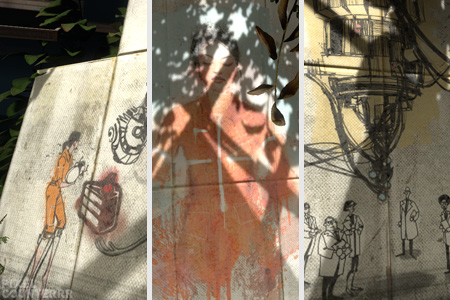
That said, to me it’s exceedingly captivating to come across unique art assets in a game with a relatively high-level of spatial freedom, which happened recently with Portal 2. Like said, Portal 2 is rather pleasant to look at in the first place, but it was the cool graffiti at the beginning of the game that really caught my eye and imagination. At this point, I have to bring up once again Walter Benjamin’s concept of the Aura of an art piece, and how the Aura diminishes when the piece is reproduced. Since real-time imagery seems to be inherently the most repetitive medium what comes to the visual building blocks, the rare and unique art assets really have a profound effect to the trained, or better, conditioned perception, like mine.

Scarcity creates value, and I would do like to see more unique assets, especially textures like the aforementioned graffiti, implemented throughout the games at large. It takes some extra work to do so, but I believe it’s easily worth it and people will appreciate the effort, if not directly, then at least at the unconscious level.

Real Virtual Things

August 5, 2011

I have always found it fascinating when reality of real-time imagery collides with the actual one. In an earlier post I discussed an artist called Susy Oliveira who, I would assume inadvertently, mimicked aesthetics of polygonal graphics in some of her sculptures, and how peculiar it is to encounter such aesthetic outside the virtual realm at large. Then there is Aram Bartholl, an artist as well, who exports, very deliberately, visual concepts only previously seen in the digital realm, like video games, into the physical reality in which they produce often an interesting visual conflict. One of his newest concepts, Dust, in particular seems quite impressive, especially if one has played heavily Counter Strike at some point his/her life.

My personal hero, though, in this field is Harrison Krix who is most well known for the Guy-Manuel helmet replica he did some years ago. However, a substantial portion of Krix’s body of work seems to consist of constructing physical props found in video games – everything from scratch. And it goes without saying that he’s ridiculously good at what he does. The attention to detail that goes into Krix’s projects is unrivaled, and it’s really freakish to see familiar digital objects, such as the Portal Gun, brought to life in such a meticulous fashion.

So, it was Krix’s work that got me thinking the exact point in the history of real-time imagery after which making such physical replicas of virtual objects became reasonable.

The most obvious technological requirement must be that the virtual object has to consist of polygons, since polygons were the first genuine solution for simulating 3D space. So, in theory, one could make, and in fact, a gentleman named Niklas Roy has made, a physical artifact based on a mere wireframe model. However, the appearance of such a physical object doesn’t really adhere to the logic of our common physical world, like Krix’s Portal Gun for instance, but of the digital realm, meaning we don’t usually have green wireframe objects lying around. Of course, the prop maker could use some imagination and make the digital wireframe object appear more of an actual object by discarding the original visual principle, but that would defeat the whole purpose of such an endeavor, wouldn’t it?

So, my wonderment lies in the question as follows: When did it become reasonable to put together a credible physical object based on a digital one without resorting too much to artistic license? Obviously there is no a definitive answer to that since it depends a lot on the shape and form of the virtual object itself (among other things), but I would say that generally speaking it may have been the introduction of normal mapping that finally rendered virtual objects sophisticated enough to be replicated in the physical world, along with relatively high polycount and texture resolution. To put it in gaming terms, the line would lie roughly somewhere between Quake 3 and Half-life 2, meaning the art assets in the former were still too abstract to be constructed and sold as real world objects, unlike those of the latter.

This all comes down to something that fascinates me more than anything, which is the indexes that correlate with the evolution of real-time imagery. Harrison Krix’s creations are indeed indexical in the sense that real-time imagery has had to evolve to a certain point to enable such a prop-making endeavor. I’m really having hard time to see Krix making abstract and blurry prop weapons from, say, Quake 2 and be equally passionate about it, but what do I know?

Scientifically Beautiful Shadows

July 29, 2011

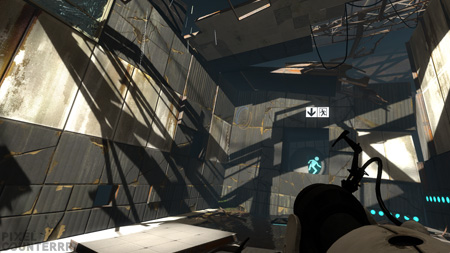
In the vain of the previous, somewhat pessimistic, post, it is only apt to discuss now cases where dynamic lighting performs extraordinarily well, one of which being Valve Software’s Portal 2.

The first Portal was a massive critical success and received huge amounts of good will from the gaming community, not least for the virtue of coming basically from nowhere as an “extra” in the Orange Box, taking everyone by surprise with its novel gameplay and a twisty storyline. One can, thus, only imagine the overwhelming pressure to succeed that must have taken place when making the sequel, Portal 2.

Unfortunately, the will and eager to top the first one shows what comes to the storyline (I’ve never cared about scripted stories anyway), but visually, it’s light-years ahead from the first one, as it should.

Indeed, Portal 2 is filled with intriguing visual details and design decisions to the point that it depresses me to single out just one for now, but, as said, one area in which Portal 2 shines the most is the overall illumination scheme. Technically the lighting consists of carefully placed dynamic lights with dynamic shadows and complementary pre-calculated static lighting, and on the surface there’s really nothing super-fancy about it.

So, even though real-time shadows per se in Portal 2 aren’t groundbreaking by any means, the impact they had on me in terms of pure aesthetic pleasure was considerable nevertheless. The intro-sequence in particular is something of a showcase, presumably by design, for the new lighting system (and for the pre-calculated physics) that differentiates Portal 2 immediately from its predecessor, conveying a message that this time Portal 2 is not a cutesy little side project, but a serious full on retail product.

In addition to the dynamic lighting, the geometry in levels, such as platforms and wall plates, are heavily animated this time around, which wasn’t the case with the first Portal. Of course, since Portal barely contained any dynamic lighting, it would have been problematic, to say the last, to move geometry around to the equal extent as in Portal 2. One function of the dynamic lighting in Portal 2 seems to be indeed to obstruct the static lighting in dynamic objects so that they blend in to the environment when they change their orientation and/or position. It’s like aesthetic cement that smoothes everything out in the end.

Besides being enchantingly beautiful in itself, Portal 2’s visual landscape is a testament for what a few, or in Portal 2’s case, usually just one, real-time light source casting shadows can do to a scene when implemented right.  Of course, Portal 2 benefits from the unreal and dreamlike environments, in the sense that the lighting doesn’t have to replicate often-convoluted natural world scenarios, but that of highly contained and stylized indoor settings instead.

And everything would be done in vane if the performance failed to deliver, which isn’t even remotely the case with Portal 2. Thanks to the art direction and partly gameplay mechanics, the levels in Portal 2 are often lightweight in terms of geometry due to their blocky and abstract architecture, which allocates resources to other things, such as real-time lighting and physics. Consequently, Portal 2 runs actually better than the visuals would let one assume, which is always an ideal scenario when dealing with real-time imagery.

Fully Dynamic Darkness

July 22, 2011

It’s almost redundant to state that John Carmack, the co-founder of id Software, is one of the most important creative minds that have ever pushed consumer real-time imagery forward. Of course, Carmack is most known for coding the graphics engines for the Wolfenstein 3D, Doom, and Quake games that each elevated the visual fidelity of simulated real-time space to a new level.

In terms of pure technology, Doom 3 has been to me the most interesting id release yet, although it received mixed reactions back in 2004, to say the least. As a game, sure, it left much to hope for, but as mere real-time imagery, Doom 3 is a pretty fascinating piece of work.

For one, as far as I know, Doom 3 was one of the very, if not the, first commercial games to include a completely dynamic lighting model with real-time shadows, and in fact, still remains to be one of the few. The idea of fully dynamic lighting is indeed beautiful and something to be proud of, but it did come with a cost – a pretty considerable one.

We all know that indirect illumination is a bitch to simulate accordingly in real-time, and since Doom 3 didn’t contain any, it was for that very reason dark as, well,  Hell. In Doom 3 if something wasn’t lit directly by a light source, the area in question remained 100% dark, which is, of course, highly unrealistic and aesthetically almost unbearable. So, even though the lighting model was consistent and performed well on paper, Doom 3 was indeed deemed too dark at the time and mods that attached a torch to the weapons surfaced rapidly, bringing more precious illumination into the darkness.

All things considered, one could say that Doom 3 (or id Tech 4, as the engine is called) was most uncompromised graphics engine that id has produced yet, in that it didn’t “fake” anything but did everything in real-time, which ended up being its weakness.

So, it’s interesting to see id now going back to semi-static illumination with their upcoming title RAGE, considering such lighting was last seen in an id game back in 1999 when Quake 3 was released (Quake 4 was an id Tech 4 game and not developed by id). Consequently, RAGE does look much better on the surface than any id Tech 4 game due to the pre-rendered indirect illumination, but ideologically it’s a step backwards.

The more I think of Doom 3, the more it comes across as a proof of concept. That Carmack had this grande idea of fully dynamic lighting solution and then ran with it, ignoring all the aesthetical problems (and of such related to realism) it created in the process. I do believe dynamic systems are worthy in themselves within real-time imagery, but simulation of light isn’t just there yet – even today, let alone in 2004 – that it could be adequately handled fully in real-time.

Mod Nation

July 15, 2011

It is often said that one of the most essential strengths of PC gaming is the ability to make modifications to the games, and I do agree to that sentiment to an extent. I believe where modding works best are the little things, like fixing an annoying camera-angle or a disruptive HUD element. What then comes to altering more essential (visual) elements of a game, like adding/replacing new geometry and textures, I’m really not that sure.

I have two main reasons not to unreservedly celebrate modding: an ideological one and a practical one.

The main ideological problem that I see in extensive modding originates from the sanctitude of an art piece, which I consider fundamental. For me, it’s crucial to experience an artifact so that the piece reflects in its every facet the original vision of the author(s). Even back when I was a kid I felt deeply unsettled when my brother altered my out of the box Lego airplane set by putting extra lights and stickers on it because “they made it look cooler”. Of course, I undid all the modifications soon afterwards, as they simply felt wrong and abusive towards the original design.

The reason for me to feel this strongly about the issue may stem from the fact that I consider myself very much a creative person, and thus can relate how bad it feels when factors beyond my control get to distort my vision.

In regard to the remix culture that produces novel art pieces out of old ones by sampling and recombination, I’m highly okay with that. But that’s the difference: A remix isn’t there to replace the original but to co-exist with it as a separate entity of its own.

That being said, I wonder who in their right mind wasn’t bothered by the digitally “enhanced” versions of the original Star Wars trilogy, especially when George Lucas tried to bury the original untouched ones? New scenes, creatures, and effects did nothing but transformed the movies into weird Frankenstein versions of themselves, consequently ruining them for everyone.

Which brings us conveniently to the second, i.e. practical reason I’m dubious about modding, which is artistic consistency. The thing is, there are several factors that affect the final look of an art piece, such as the era the piece was produced in, or the technology being used, but most importantly, the artistic judgment of the art director who assures that in the end everything fit together.

So, modding (sans total conversions, which is a whole another issue) doesn’t have that benefit of one coherent visual view on things that comes with an adequate art direction. I would go even as far that modding can be, at worst, a violent act of injecting an alien component into a carefully designed visual ecosystem, which then throws the whole aesthetics scheme out of balance. For instance, I have yet to see a Grand Theft Auto IV car mod that blends perfectly into the environment, like the native cars do. Modded cars, while being often high quality and beautiful objects in themselves, just lack the look and feel provided by the original art direction, which makes them pop up like a sore thumb.

Obviously, I’m not saying that it’s impossible to have great, consistent results with extensive modding. I’m saying it’s pretty damn difficult to pull off nicely, which becomes apparent by just glimpsing at the modding scene at large.

In short: modding is harmless, but unethical (in the mildest sense of the word) and usually unaesthetic, fun.

Think of the Children

July 7, 2011

It’s interesting that I have never had a problem with video game violence, considering how sensitive I’m of seeing real blood and injuries in still images and videos. Even fictional violence in movies has made me look away, like that of, say, RoboCop’s at the time, although not so much anymore as an adult. Okay, of movies of late the Saw series has made me fast-forward some over the top scenes, but otherwise, I’m starting to be cool with almost all kinds of (fictional) movies.

In regard of actual violence, I’m actually so appalled by it that it gets me even in such an abstract form as thermal imagining camera footage that one encounters in the media from time to time, in which barely recognizable, pixelated human silhouettes get shot into pieces. It’s indeed not the graphical representation of violence in itself, but the mere idea – the belief, even if false – that someone is actually getting hurt that makes my guts shiver.

So when dealing with simulated violence like such found in video games, there’s not even a slightest chance that the object of the make-believe cruelty is real, sentient being, in contrast to movie/video footage violence (cartoons etc. aside), which leaves always the door open regarding that question – at least in theory. A case in point is the cult movie Faces of Death which contains real and fictional acts of violence mixed together in a fairly ambiguous fashion.

It’s pretty given that violence has always been part of video games in one form or another, if we consider violence as an act of disintegrating an opponent, what it basically is. However, if we determine the official birth of video game violence as the moment when the mainstream media got interested and “concerned” about it, I believe it was Doom that first raised some serious headlines back in 1993. In many senses, Doom was a perfect storm: a revolutionary ray-casting technology, killer playability, and, of course, unprecedented graphical violence.

Yes, there’s no denying the splattering blood, exploding bodies and the controversy that followed the game did have very much to do with the success of Doom. I remember reading reviews that made a big deal of the violence, making it clear that Doom was definitely not for kids, which wasn’t something a video game reviewer had a chance to say so often back then.

This is interesting, because while the concern regarding the violence in Doom surely was sincere to a certain extent, there was at the same time an underpinning sense of pride that came across. That finally video games were able to depict violence in such detail that it could actually harm the psyche of a kid growing up, which was, of course, a bit alarmistic sentiment considering how abstract and blocky Doom was. In addition, the pride stemmed as well from the fact that the mainstream media finally acknowledged the existence of video games, even if in somewhat unfavorable light. And video games and gamers have always craved for acknowledgment if anything from the “outside world”, which Doom provided plenty of back then, thanks to the violent nature of it.

Above resonates actually with the case in which an Iraq veteran allegedly suffered from flashbacks through playing Call of Duty 4: Modern Warfare. Of course, in principle, it’s a terrible thing that a man loses his marbles that way, but as a gamer, it brings me some strange pride that a video game can have that kind of an effect on someone. As if the reality is finally starting to intertwine with the simulation, which is the goal of the whole video game project, isn’t it?

All in all, video game violence, for me, is simply a sophisticated continuation for childhood play and games in which toy soldiers got blown up by firecrackers, or mutilated in some other way. It’s just very difficult to see anything more to it.

As I stated in my thesis in Chapter 4.2, there really is no ethical dimension whatsoever in simulated violence, as long as the analog is a non-sentient being.