For Your Eyes Only

April 24, 2010

Simulation of human sight in video games is a tricky business. Usually it’s done with replicating features of human perception, which can be found also in a camera: motion blur, depth of field, exposure control and so on. One particular effect that is very popular at the moment, is the so-called HDR (High Dynamic Range) –effect, or “bloom” to which it is often erroneously confused. If you have played Battlefield: Bad Company 2, you know exactly what I’m talking about. In BC 2 the effect is so hideous and extreme, that I had to uninstall the game partly because of it. Furthermore, there are two other games in which the effect is almost equally unbearable but, however, don’t render the whole game unplayable: Techland’s Call of Juares 2 – Bound In Blood and Codemasters’ Operation Flashpoint: Dragon Rising. These screenshots below don’t really do “justice” for the effect, since it’s even more irritating in motion.
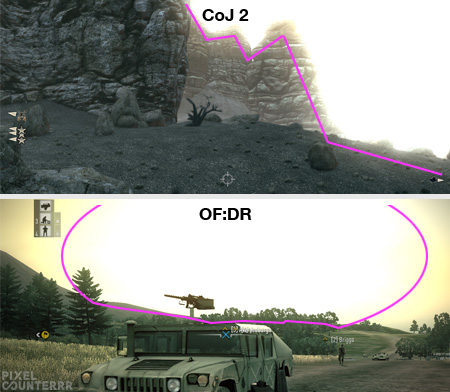
The effect should simulate human eye’s finite capacity to handle different volumes of light. The eye has this thing known as iris which regulates the amount of light hitting the retina in order to avoid over or under exposure. The eye is constantly adapting in new lighting conditions with little delay and this is what HDR –effect has come to simulate for.

However, it seems, that HDR –effect and post-processing effects by and large have become masking devices for graphics’ deficiencies and shortcomings, which is really sad. I can imagine how easy and tempting it is just to crank up the post-processing effects, when your game’s visual landscape doesn’t deliver otherwise. But when the effect is done right, it really is a valuable addition to the experience. In Call of Duty 4: Modern Warfare the effect is so subtle you barely notice it, but when you do, it works every time. Respectively Crysis does the HDR –effect exactly right, and the way Crysis handles all other post-processing effects should be ordered as mandatory to every developer making video games.
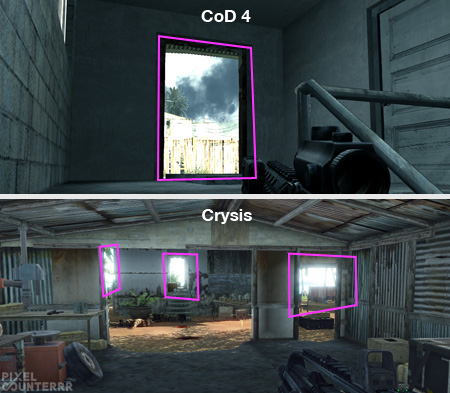
Final verdict is: do it, but don’t overdo it.

Curious Case of Saleen S7

April 22, 2010

I happened to have installed three different games with basically the same car Saleen S7 modeled in them, so it was an opportunity not to miss to compare the models to each other. The games are SimBin’s GTR 2 (2006), Eden Games’ Test Drive Unlimited (2007) and Codemasters’ Race Driver: GRID (2008). It’s interesting to notice, how in span of three years polycount has dramatically increased, but also how different approaches developers have on modeling basically identical shapes. Polycount doesn’t include interior so that models would be more comparable in that way.

All this got me thinking if in the future, where there are no performance issues related to polygons any more, there will be a culture of sharing art assets used in games between the developers. In that way, developers could co-operate by licensing the same basic shapes (like S7 for instance) and there wouldn’t be a need to start every model from scratch. Understandably 3D models have to be currently designed from ground up into every particular context of use in order to optimize the performance. Obviously there are subcontractors easing developers’ workload already, but I’m talking about universal sharing and licensing system which isn’t, at least to my knowledge, there yet.

Notice the evolution of the tail lights, and different kind of trianglization  in the GTR 2 model.

Pussy Cat Ragdolls

April 21, 2010

Company named NaturalMotion introduced years back ragdoll physics system known as Euphoria, which simulates human muscle and nervous systems. I saw it back then as the biggest revolution in gaming since 3D acceleration, but what happened? Only two (2) game utilizes Euphoria at the moment, which are Rockstar’s Grand Theft Auto IV (if we consider GTA IV and recently published Episodes from Liberty City as one title which they basically are) and LucasArts’ Star Wars: The Force Unleashed. The third Euphoria game is coming out soon, which is also a Rockstar game, Red Dead Redemption. And the upcoming fourth one is something I’m  personally not that excited about, so let’s leave it that way.

It’s beyond my comprehension why Euphoria hasn’t taken off like it definitely should have. Nothing makes me smile more than the reactions of characters getting shot or run over in GTA IV, which sounds actually pretty horrible said out loud. Anyhow, it’s just frustrating to imagine, how much better experience, for instance, Assassin’s Creed would be with Euphoria in it. Or Modern Warfare 2 which has pre-industrial-age physics (Infinity Ward, you are better than that!). It’s just a sad situation of which makes it even worse that Euphoria has no real competition (quality wise) in the market. Havok and PhysX try their best, but sad to say they don’t play even in the same ballpark with Euphoria, especially PhysX with its springy ragdoll-physics. But those two are apparently easier and perhaps cheaper(?) to license and implement.

Just give me Euphoria in every game, plz.

Got to Go Out More

April 20, 2010

Funny thing happened when I laid my eyes on this picture:

I saw artifacts of a low resolution shadow map there, I couldn’t help myself. It just really looks like that, doesn’t it?

Bleeding Walls of Modern Warfare

April 20, 2010

It seems in Modern Warfare 2 things other than enemies bleed as well: the walls. I believe, this is the first case of real-time color bleeding (Mirror’s Edge has the best pre-baked color bleeds par none) in video games and it really is an amazing effect. In situations like this, the MW 2 –engine truly excels and the Favela level is the prime example how gorgeous video game can look on these days. Infinity Ward – regardless all the recent drama – posses some impressive technology and pure skill, I can tell you that.

Of course we are not dealing with genuine radiocity here, but either way, MW 2 fakes it pretty damn well.

Shadow of The Assassin

April 20, 2010

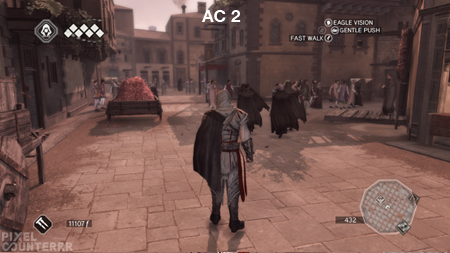
Ubisoft Montreal’s Assassin’s Creed got its sequel a few months back and now that the dust has settled, it’s intriguing to compare it to its predecessor. Overall they look much alike and the biggest thing must be the dynamic time-of-day system incorporated in the sequel, which technically speaking works pretty well. However, there’s usually a trade-off going from static to dynamic and Assassin’s Creed 2 is no exception on that matter.

If you look at above screenshot from AC and then the other one below (although it’s been purposefully chosen to demonstrate AC 2‘s weaknesses), overall lighting and look in AC 2 is just less interesting and flat in comparison to AC and that’s the problem which comes with the dynamic time-of-day lighting. Developer just cannot realize aesthetically pleasing visual look to every possible lighting condition and the real-time lighting technologies for that task, like global illumination or radiocity, aren’t simply there yet.

Real-time shadows overall look also better in AC. In AC 2, there is this flickering effect, which is especially apparent in the distant shadows due to their low resolution, but it’s noticeable in near ones too. The shadow system as a whole feels pretty unstable in AC 2 and the problems clearly stem from the dynamic nature of the shadows, since the same problems are absent in AC.

Dynamic time-of-day sounds great on paper and it’s a nice bullet-point in the feature list. I occasionally even longed for it while playing AC but I’m now starting to lean towards fixed or dynamic-but-developer-controlled lighting, like in Crysis. Or at least I’m on the fence about that. It feels funny to say so, since I’m all for simulating the dynamic systems – that’s what video games are all about! Dynamic time-of-day just adds surprisingly little to overall experience, considering all the visual problems it creates.

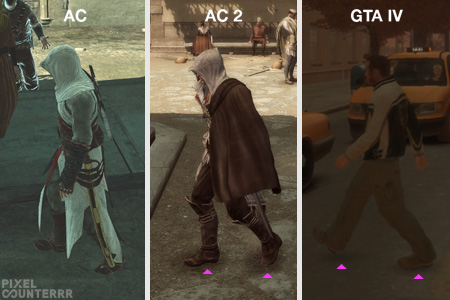
Nice little touch is the new “shadow-sandals ” like in Grand Theft Auto IV in which the effect is actually  far more sophisticated. Anyway, the effect provides an important connection to the ground, especially in fully shadowed areas. It’s like a poor man’s ambient occlusion, emphasis on poor.

No It Doesn’t

April 20, 2010

http://www.neogaf.com/forum/showpost.php?p=20848509&postcount=1402

I beg to differ.