The Problem Is Choice

May 26, 2010

Every game has this sweet spot in which the graphics engine performs and presents itself optimally on the screen. Obviously, those are the very same spots from where the screenshots for marketing are taken.

The thing is, the more freedom the player is given to, the smaller the sweet spot becomes, relatively speaking. At the dawn of the video games, one actually couldn’t take a bad screenshot of the game, since practically all the screenshots were “good”. Games back then just looked pretty much the same in all possible situations, like Pong or Space Invaders, and that’s because of the lack of freedom player had in the game.

With freedom, comes not responsibility, but a choice. Player can choose to fly low in Tom Clancy’s HAWX and expose the weaknesses of the graphics engine, or otherwise act so that her dealings break the game. This freedom to choose is the weakness and the asset of the medium at the same time, the weakness being the impossibility to merge total freedom and storytelling, which is why we still have the archaic cut-scenes around.

So, it was the 3D –graphics that introduced this issue with freedom, because the latitude of the player became exponential in comparison to 2D –space in which the objects were always in fixed distance of the screen. The player could now wander off from the sweet spot to examine objects up close and to see the flaws and limitations the graphics engine posed. The situation is like getting up from a ghost train ride to see which material the coulisses are made of.

The absolute freedom given to people hardly ever leads to preferable situations, in video games as in real life. Today’s game designers have to take account more than ever, that people will exercise the freedom they are given to and take a closer look at what the designers have created, and (in worst case scenario) post the glitches and intentionally ugly screenshots online to diss the game or the system it’s on. And to take that freedom away with invisible walls, for instance, is like asking a verbal abuse and beating from the online community.

And who can live with oneself after that?

Let’s Take This Outside

May 19, 2010

The most straightforward (but rarely the best) way of solving everyday conflicts is good ol’ street fight. While the real thing isn’t much to look at in aesthetic sense, the same definitely doesn’t apply to Capcom’s Street Fighter IV. SF IV can be considered as remake of the year 1991 Street Fighter II – World Warrior, since the cast of characters of SF II can be found entirely from SF IV and the overall feel is very much alike.

SF IV is a true visual masterpiece and a benchmark for its kind. It’s like looking at living, ever-changing oil painting which is updating 60 times per second – in real-time! The interesting thing is, that because SF IVlike its predecessors – is presented as a stage of a theatre, it’s been possible to target all the resources into relatively compact space. So, the resources-per-inch -ratio has to be record high on this one, which becomes evident just by looking at it. SF IV is absolutely gorgeous.

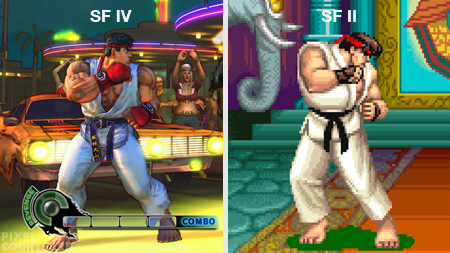
It’s also interesting how both SF IV and SF II adhere to the same visual principles (side-view, camera pans etc) even though the techniques that have been employed are completely different. This similarity provides the basis for the following comparison of the characters realized 17 years apart.

Above illustrates the rise of pixel count found in the characters as they appear on the screen. It would be, by the way, rather frustrating (if impossible) task to animate by hand a sprite of SF IV’s size, with reasonable frame-rate and proper shading.

Notice how the polygons used in SF IV are often a fracture of the size of the pixels found in SF II, which is pretty amazing and revealing how far we have come.

The 2D – 3D dichotomy is one of the most fundamental and profound concepts found in real-time graphics and it was intriguing to see how 3D, i.e. polygon-based graphics finally surpassed the hand-drawn 2D imagery visually. It was a long time when 3D was nothing but simple geometrical shapes with poor frame-rate, but now 3D can be, as said, on a par with a sophisticated oil painting.

So, when did this happen exactly?

The Light Side of The Dark Forces

May 7, 2010

Back in the 1995, in the wake of the Doom-generated first-person-shooter-hype, LucasArts couldn’t help but make one themselves, Star Wars: Dark Forces that is. Doom was known for its graphical breakthroughs, including buttery smooth frame rate in majority of computers and diverse lighting, but particularly of its addicting multiplayer component, which was literally a game-changer. So, why didn’t LucasArts incorporate multiplayer on their doom-clone, while the multiplayer was the hottest thing out there at the time? One reason they gave us was they wanted to concentrate their resources solely to “excellent single player”, but I’m not buying that. I think the real reason for leaving multiplayer out was an aestethical one.

Doom and majority of its contemporaries, including SW:DF, used this technology called ray-casting which allows fast but limited 3D-space to be presented in your screen. There are two types of lighting in developers’ disposal when using this kind of ray-casting: static and dynamic, and the latter is unsurprisingly the problematic one. The dynamic lighting (or should I say shading) is realized by using something called depth cueing which darkens objects afar in order to simulate darkness (or in some cases fog) and to give certain kind of depth to the image.

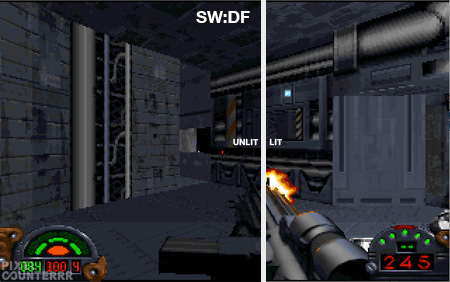
However, the shading is constrained to distinct layers parallel to the screen due to the ray-casting technique and the limitations it poses.

The parallel layers can be easily spotted in SW:DF and alike and they have to do with the optimization of the performance.

When comparing SW:DF to other similar games, SW:DF seemed to have more sophisticated way to light its surroundings when firing the gun. In SW:DF the light emitted by player’s gun illuminates more realistically only the nearby surfaces, while in Doom the whole 3D space flashes evenly when using a weapon, which is rather unrealistic apporach.

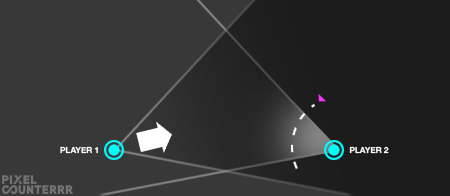
The depth cueing really is, and was even then, the oldest trick in the book. Anyhow, the way SW:DF employs it, is not only to dim visibility in the distant, like it’s used in Doom or alike, but also to add brightness near when using weapons or the flash light and that’s the reason in my mind why there was no multiplayer in SW:DF. While the effect is feasible to render from the perspective of the shooter (but since the shading engine can operate only on parallel slices), it would be impossible to render in a multiplayer mode radial lighting the player 2 emits from the player 1’s point of view.

What backs up my case is that another ray-casting title 3D Realms’ Duke Nukem 3D, released a year later, didn’t have the SW:DF‘s gun lighting solution but did have a multiplayer. And so did the Shadow Warrior released year after DN3D also by 3D Realms.

Of course, there would have been plenty of workarounds for the situation, for instance they could have just ignored the effect altogether in multiplayer mode but that would have been a compromise from LucasArts’ behalf. Perhaps they hated compromises as much as I do.

Real-time graphics truly has always been about dreadful trade-offs and compromises, and I don’t see any change in that in the near (or even distant) future. In a way, those things make the real-time graphics even more exciting, since the limitations often feed creativity.


Big Visuals in Little China

May 3, 2010

Rockstar’s Grand Theft Auto: Chinatown Wars is an interesting “back to the roots” –type of thing. It throws away now familiar third-person perspective, just to go back to the bird-view found in the first Grand Theft Auto from 1997. I had a privilege to come across with the iPhone version of the GTA:CTW, and it nevertheless exceeded my expectations (if I had any). But still, since it was originally developed for Nintendo DS which has a far more sophisticated hardware than iPhone, I knew constantly in the back of my mind that there was a better version out there: a definitive version. Therefore, I made an early decision to not look at the DS –version before I had my time with the version I possessed and I’ll reflect later why.

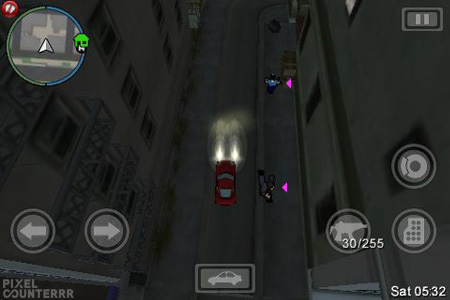
iPhone’s GTA:CTW is one of the greatest looking games on the platform, Zen Bound being the best at the moment, in my opinion. What amazed me was how detailed the world is: cars have working turn/reverse/headlights, there is a dynamic time-of-day –lighting (which works fine and is well justified on this one) and weather effects with credible lightnings and so forth. Additionally the performance is excellent with little to none hick-ups with the frame rate.

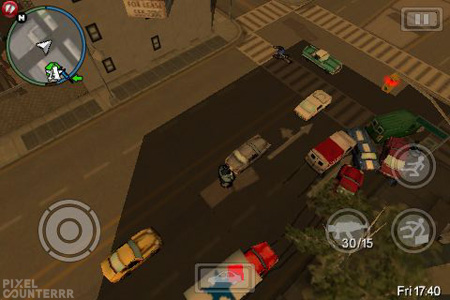
As said, the perspective is now similar with the first GTA, but still not quite exactly the same. In GTA:CTW the view is little tilted and therefore perhaps more three-deey. What’s interesting is how well sprites work with a tilted view, which is rather counter-intuitive. And thanks to the perspective, there is practically no pop-up to be seen, like in GTA IV in which pop-up is constantly rubbed in your face. So in fact, GTA:CTW‘s visuals are more coherent in that way.

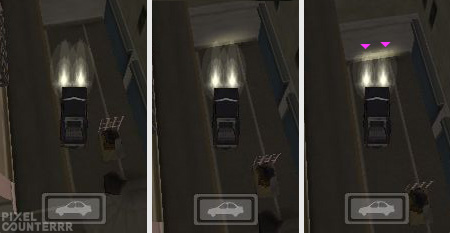
Notice how the light beams react accordingly to the walls: there’s much more going on than simple decals there.

To be honest, the sole reason why I was so impressed with the game, was the platform. You always perceive things through a framework. With video games it’s the hardware which constitutes certain kind of expectation for the visuals. It’s funny how reluctant I still am to look at the superior sceenshots of the DS –version, because I know my iPhone –version is the compromised one, and I hate compromises.

In a way, it’s sad that it’s so hard for me to enjoy things that are not presented, as “they should (or could) be”. It really is. I think it’s deeply rooted in human nature, and it must be one form of “keeping up with the Joneses”: we’re not satisfied with what we have if there is a reasonable possibility to have things a little better.

Tearing Toys Apart

April 28, 2010

For me, a new video game should always be served as shrouded in mystery. It gets me every time, when installing a game I see the names of the files and subdirectories – which can be very revealing – flashing before my eyes, right next to the progress bar. For instance, there is often a subdirectory like “levels”, in where you can easily see a glimpse of the whole structure of the game.

But, when I’m done with the game, it’s okay to take a look what is under the hood. Like with DVD you don’t watch the extras and making-ofs before the feature itself, do you?

So, when you start extracting textures, geometry or even modding the code beneath the surface (which I’m unfortunately not capable of doing), the game looses in a way its final layer of secrecy. It’s like the stripper’s last garment been taken off before collecting money and leaving the stage (not that I’m familiar with such things).

The thing as a whole is a lot like with kids smashing their toys in order to see how they work, but loosing the charm of the object in the process. I remember as a kid having a toy Pontiac (that KITT -one) with dimmed windows through which you could see the interior very vaguely against the bright light, as a silhouette, if you will. It always boggled me how the dashboard and other stuff would look like without those concealing windows. Anyhow, I later saw the same toy car in my friend’s house with the broken windshield, so the interior was wide open for viewing: my friend appeared to be the weaker one on this matter. But instead of jumping around out of excitement, the exposed interior just looked sad and made my toy car less interesting.

Why do we have this tendency of destroying the things we treasure?

So Different, So Alike

April 26, 2010

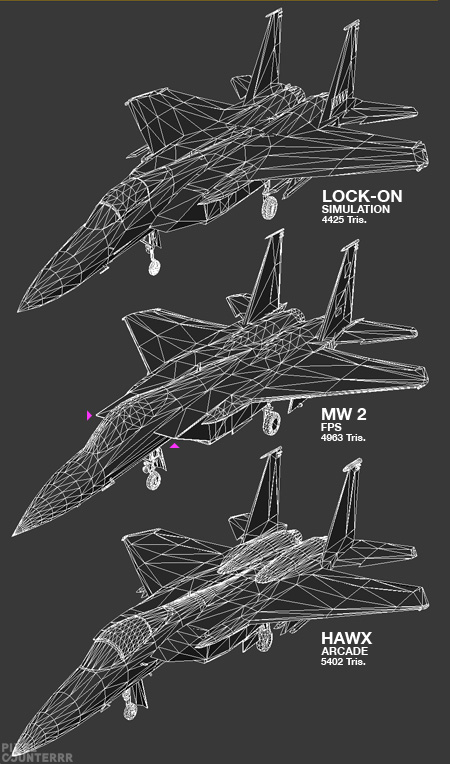
As I said earlier inSaleen S7 -case, as long as there is a certain budget for geometry, every object has to be designed for the context of use. In Saleen S7 comparison, the car models played practically the same role in each game, so the year of release was the most relevant variable in that equation. In my following F-15(C) –comparison, the situation is a little more complex, as we see later. The games are Eagle Dynamic’s Lock-On: Modern Air Combat (2003), Infinity Ward’s Modern Warfare 2 (2009) and Ubisoft Romania’s Tom Clancy’s HAWX. (2009).

So, what makes this particular comparison interesting is, that the models are taken from such different places: first is from a 7-year-old hardcore simulation, second is just a background piece in a first-person shooter and third is from a modern arcade simulation. And still, the polycount is strikingly similar so let’s contemplate that a little.

If we look at Lock-On, the polycount of its F-15 was actually fairly high, considering the year of release. Lock-On is a hardcore simulation, so the focus is on the plane itself and especially on its uncompromised interior (which is a whole another model).

In HAWX the focus is definitely on the amazing terrain, so majority of the polygons have been obviously poured on there. So, even though Lock-On and HAWX are games 6 years apart, the polycount of the planes are similar because of the different focuses: one is focused on the plane and the other one is on the environment. Confusing?

Respectively in MW 2, the F-15s are just set pieces, visiting player briefly on the screen, so focus is not entirely on them but on the scenery at large. Still, what amazes me is the level of treatment they nevertheless have had in the development process: those F-15s look pretty damn spectacular when they glide slowly by your helicopter you’re sitting on.

Interestingly, when comparing the models to the actual F-15, the geometry found in HAWX’s plane was the most inaccurate. What makes the situation funny is that HAWX is a game about jet fighters, in contrast to MW 2 which is definitely not. Furthermore, HAWX is ironically the only game officially endorsed by F-15’s manufacturer, Boeing. Okay, MW 2 fighter’s blocky air intakesare little weird but overall it’s surprisingly accurate, and so is (less surprisingly) Lock-On’s model.

Fashionably Retro Camouflage

April 25, 2010

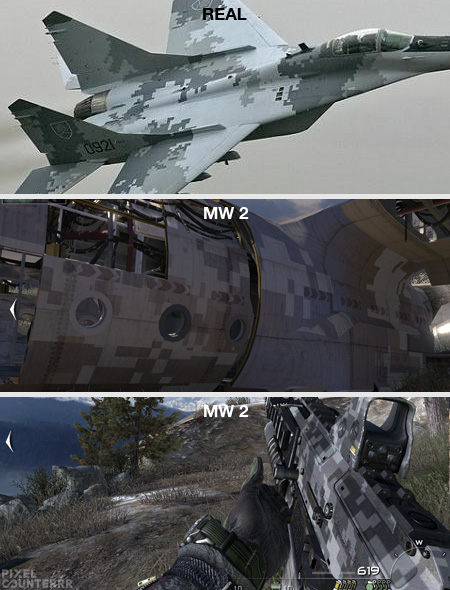
You may have noticed this trend in military scene, where they have started to use pixelated camo-patterns in their combat wear and hardware. I personally can’t think of any reason for it other than it just looks cool, but apparently it’s more effective camouflage.

This trend becomes an interesting phenomenon, when it’s encountered in video game context. Finally we are in a place, where resolution of textures is sufficient enough, that it takes an effort to differentiate singular pixels on them and then, at the same time, the real military starts to use low-resolution patterns in their gear. The circle of life.

Pixelated camo in video game environment gives it this unintended cool retro-look, thus it’s been a while since the last time pixels were of this caliber in your screen, like in Modern Warfare 2. Interestingly, the pixel-camo texture was nowhere to be found when I studied the texture data from MW 2, so it must be some kind of procedurally generated texture layer at top of the bitmap (or I just missed it somehow).

So, it has be rather weird and schizofrenic for the artist to create such high-resolution texture of which content at the same time mimics low-resolution imagery.

But when does low-resolution per se become purely an artistic decision? Then, when the resolution is not a technical issue anymore and we are partly already there. Just like the number of colors is not an issue in video games, so there are games at the moment, which make an artistic choice to limit theirs coloring scheme, like Madworld for instance.