Drawing The Dark Knight

July 19, 2010

Rocksteady Studios’ Batman: Arkham Asylum seems to be (to my knowledge) one of the first games to address the ethical problem that comes with the high body count and you, the player, being the supposed good-guy. The fact of the matter is, in this game you don’t kill anyone, you just knock them out, including the main villain. Even when you push a guy into an endless-looking abyss, you hear a reassuring splash of water whispering soothingly into your ear: “He’ll be okay, don’t you worry about that, big boy.” But that’s a minor and more or less trivial detail of the game.
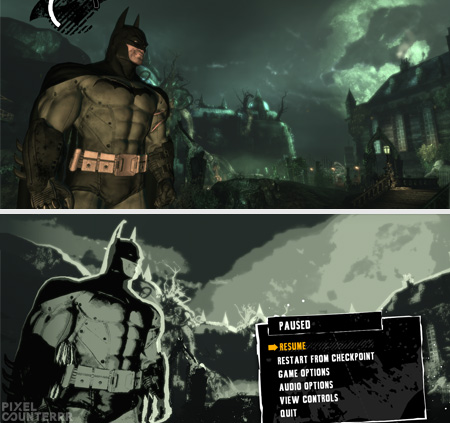
More interesting detail is the fact that B:AA isn’t visually anything special… until you hit the pause screen. When doing so, the game renders the screen as if it’s been taken straight from Sin City or alike. The effect is eye-meltingly good and makes you wonder what if they would have made the whole game look like that. Now the pause screen is like a nod to the player that “Yes, we could have done it this way, but we didn’t. Sorry.”

Ok, the effect in question is a bit extreme and perhaps it would have rendered the game unplayable by making it too hard for player to make sense of. This comes actually back to the problem of freedom the player has in video games, in contrast to non-dynamic mediums, like movies and graphic novels. When working with old mediums the director/artist has the absolute control over what the spectator sees and hears, which enables highly stylistic and even abstract ways of depicting things, but still keeping the viewer on board what’s happening. Samurai Jack’s certain stylistic scenes are good examples of that.

I’m a big fan of cel shading, and I consider it as one of the biggest breakthroughs in history of real-time image, especially the outline effect. I truly think there’s something magical about seeing something like B:AA’s pause screen to be drawn in real-time knowing that you can affect the outcome by rotating the camera or adjusting the character’s position. It’s like having a personal Frank Miller at your disposal, but not quite.

Madworld, Borderlands, and not to mention cel shading grand-daddy Jet Set Radio, already have proven that a stylistic rendering method can work and add a lot to the experience. Would the cel shading made B:AA a better game then? Perhaps not, but it would have made it definitely more interesting looking game, that’s for sure.

I Shot The Sheriff

July 13, 2010

There would be so much to say about Rockstar Games’ Grand Theft Auto IV, and in fact, much of it has already been said. However, it frustrates me to see how much the GTA IV’s storyline and its “groundbreaking narrative” have been as a topic of the discussion, mostly by the mainstream outlets. People must think that rambling about narrative in every possible situation makes them look sophisticated and intellectual, even if they miss the whole point of the work. Believe me or not, but a project such as GTA IV is not about telling you a story. It’s about letting you do stuff by simulating the stuff.

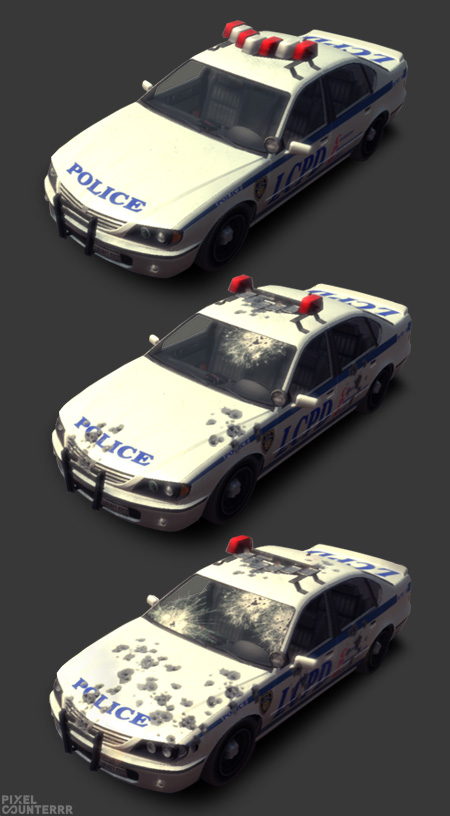
One thing that GTA IV lets you do is of course the shooting. Even though the shooting mechanism can be a bit sloppy here and there, the effects of exercising the Second Amendment definitely aren’t. GTA IV does a phenomenal job depicting bullet impacts, not just with excellent physics, but also with spot-on texturing. Bullet holes are so good that they could almost be part of the original texturing, in contrast to flat sticker-like holes seen in many other games.

There are many things that make GTA IV’s bullet holes great, first of being the vast number of them at once. Yes, there is a limit for them, but the number is so high that it’s basically a non-issue for a casual gamer.

Secondly, the bullet holes themselves are fine pieces of work. They are highly dynamic so no two blasts from a shotgun are the same. But more importantly, they use some kind of parallax mapping technique on them, so the holes have real depth when observing them from different angles. I’m not saying GTA IV is the first one to use such technique, but I’d say GTA IV pulls it off quite nicely.

Notice how dense of a mesh – at least – it would take to model (without creating new geometry) such holes with polygons, so parallax mapping is a Godsent for the situations like this. In addition to illusion of depth, the holes also shade accordingly and even have specular highlights on them.

Besides making great bullet holes, I genuinely think Rockstar Games is one of the few developers out there who really gets the medium. They are doing exactly the things of what we all fantasized playing in the future, as we were kids. GTA IV in many ways was the pie in the sky decades ago for the gamers like me – the pie which is now full-blown reality. So, are my gaming needs satisfied now for good? Hell no.

So, when does the Grand Theft Auto V come out?

Need For Cockpit

July 10, 2010

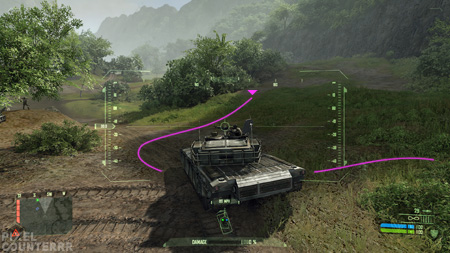
I’ve always been an avid fan of the first-person view. It just feels so natural way to experience the game world that it makes one think, why there are any other views available in the first place. Of course, I recognize the usefulness of other types of views, like the third-person view, and I very much enjoy playing some more arcadey games from that perspective, there’s no question about it. But whenever I’m playing a game which strives me to feel “being there”, like simulations often do, it’s my demand that there’s a first-person view available, at least as an option. It bugs the hell out of me when in Crysis viewpoint suddenly jumps into the third-person when entering a vehicle. Concerning that, I have to give the Official Honorable Mention to Far Cry 2 for its categorical use of the first-person view in whatever player is doing, even though as a game it didn’t do much for me.

However, this is not about above mentioned games, or their deficiencies, but about first-person view particularly in racing games.

When Polyphony Digital’s Gran Turismo 5 was demoed for the first time few years back to the wider audience, it was the same exact moment in history when gaming industry came to realization that, from then on, cockpits in racing games have to be taken seriously. That GT 5 -demo simply destroyed the competition that was out there at the time, and in a way, still does.

So, even though GT 5 looks gorgeous when driving from behind the wheel (judging again from the videos and screenshots), I would consider Slightly Mad Studios’ Need for Speed: Shift as the first first-person driver. NfS:Shift models effects of high-speed and the g-forces the driver is experiencing like no other driving game by blurring, shaking and tinting the screen. And even the HUD reacts accordingly to the collisions and everything, which is pretty crazy if you think about it.

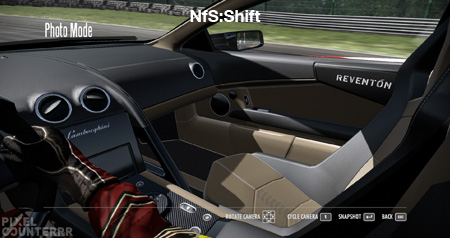
But the biggest selling point of NfS:Shift and the justification for its existence are the marvelous cockpits. The look and feel of the cockpit-view in NfS:Shift simply blew my mind: reflections of the interior in the windows, functioning gauges (including oil pressure, engine temperature, etc.), all the different materials, and well animated hands steering the wheel. Plus, the real-time shadowing is superb and almost bug-free (GT 5, I’m looking in your direction).

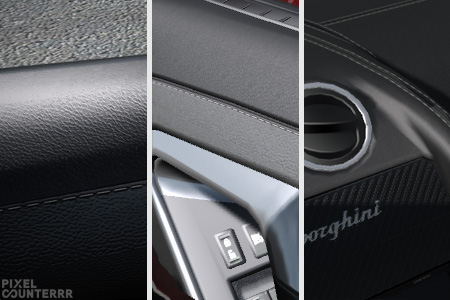
Look at all the detailing on the NfS:Shift’s dashboards. You can almost feel the stitching on the leather only by looking at it. Total craftsmanship.

It’s pretty safe to say that NfS:Shift was obviously designed from the ground up to be experienced through the gorgeously modeled interiors. So, this got me thinking, why there’s a third-person view at all in such game? Ok, I’m all for options, but in some cases developer should own a pair and make a design decision to exclude something which undermines the game’s premise. And let’s face it, when playing NfS:Shift from the third-person view, it just becomes another arcadey driving simulation, nothing more, nothing less.

And not even particularly good one.

Let There Be Less Focus

July 5, 2010

One of the biggest problems in simulation of depth by real-time graphics is that everything is in focus by default, which is pretty unnatural state of affairs considering our eyes’ limited ability to focus on objects on various depths. Even the newly hyped stereoscopic technology, which I very much dislike, doesn’t address the problem of depth of field (DOF), because one is still staring at a flat image, but only at two instead of one. At the end of the day, completely sharp images, especially when there’s stuff very close in front of you, don’t bear much depth without the DOF -effect, which is why it has to be created artificially, i.e. simulated, when necessary by post-processing.

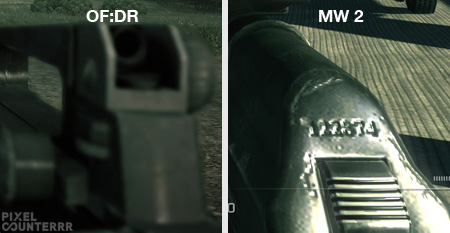
On that note, earlier I gave a bit of flack to Codemasters’ Operation Flashpoint: Dragon Rising for its over-the-top use of HDR –effect, but what I didn’t mentioned was the one thing OF:DR really does right, which is the DOF –effect. It is spot on. What makes the effect so nice is that there is this constant and subtle DOF –effect going on all the time, and not only when the player is looking through the sights, like it often is with first-person-shooters. I really can’t overstate the massive impact the constant DOF –effect gives to the OF:DR’s visual landscape, and it makes me wonder why the effect isn’t been used more often in other games. I’m sure this kind of DOF would have perfected, for instance, Modern Warfare 2’s already polished look. Ok, I don’t know exactly what the hit to the performance would be keeping the effect constantly on, but I suspect that performance wouldn’t be a major issue. After all, we are talking about rather straightforward post-processing effect here and OF:DR handles it fine.

Furthermore, the constant DOF –effect, besides providing an enhanced feeling of depth, it conveniently blurs the critical parts of the weapon which are extremely close to the camera, and would so otherwise present particular weapon textures in an unflattering light, so to speak. As you can see, MW 2 clearly (pun intended) suffers from this when using some of the weapons.

Interestingly, I would consider the first-person scene from the Doom movie as a benchmark for how a first-person-view should look like in terms of DOF and overall feel, including the movement. Yes, I do acknowledge, that judging by the screenshots and gameplay videos, Guerilla Games’ Killzone 2 (and 3 for that matter) does pretty phenomenal job with constant DOF -layering and everything, but I’m a little hesitant to comment on that since I haven’t played it personally and I don’t have access to a copy. For the record, gun loading and clip changing look in Doom movie (2005) and Killzone 2 (2009) awfully similar.

Artificial depth of field is a complicated thing to pull off, because in real life, we have a freedom to focus our sight on where ever we want to along the z-axis. And because flat image lacks the z-axis altogether, that freedom vanishes and developer has to choose the focus for you, when using the DOF –effect. But in some cases, it works great and adds a lot to the overall immersion.

Area Shadows, Where Are You?

June 25, 2010

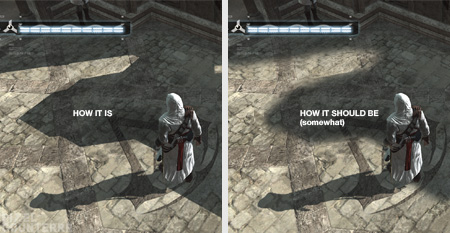
One feature that is pretty top on my wish list for real-time graphics is genuine area shadows. The shadows in question are results of so-called area lights which are light sources with spatial dimensions, like a sphere, a plane or a box for instance. The thing is, light sources with dimensions are so complicated to simulate in real-time that they are basically replaced with point light sources or their variant, directional light sources which behave, unfortunately, more often than not very unrealistically. Point light source’s main problem is that it always casts evenly sharp shadows no matter what the circumstances are, even though in real life, shadow’s softness increases as the distance increases between the object and the surface on which the object’s shadow is cast. Admittedly, the look of the shadow depends highly on the shape of the light source also, but still, the underlying logic remains as described.

This lack of area shadows creates all kinds of problems, which become increasingly evident the more there is distance between the shadow casting objects and the shadow receiving surfaces. That is to say, in small distances, point light sources work fine.

If you look at the left screen shot from Assassin’s Creed, the Altair’s shadow is perfectly acceptable, whereas the shadow cast by the distant wall in the background is obviously not.

Interestingly, in Crysis, there is this one particular level located in a valley in which the real-time area shadows are at least triedto simulate. It’s pretty given that laser sharp shadows cast by the hillsides would have looked rather silly, so evidently Crytek had to do something about it. The problem was, though, that they had made such a big deal out of their dynamic time-of-day lighting in Crysis that basically any static solution was ruled out from the get go. So, what they did was they used extremely (and I mean extremely) low-resolution shadow maps to mimic the softness the shadows would have had in that setting. Okay, so far so good. However, because the lighting conditions change as the sun travels in the sky, the shadows must update themselves constantly. Now we encounter the same exact problem the Assassin’s Creed II had with its shadows. That means, those particular shadows in Crysis stutter like there’s no tomorrow.

The solution Crytek came up with lighting that particular level of Crysis could almost be considered as a desperate move. They had painted themselves into the corner by dogmatic design decisions made early on (like dynamic time-of-day), and thus grabbed to whatever solution was left there. In still images the solution looks rather good, but in motion, not so much.

We are yet to see true real-time area shadows in video games, and I wonder how long it’s going to eventually take us to get there. Given the mathematical complexity of the area shadows, I’m afraid it’s going to  take a while.

UPDATE: There is some kind of emulation of area shadows included in Direct X 11 SDK dubbed as “contact hardening shadows” which is used only by STALKER: Call of Pripyat at the moment. I wonder how it performs in extreme conditions, though.

There’s Something About Machinima

June 22, 2010

I remember back in 1994, or was it 1995, when I first saw SEGA’s Virtua Fighter 2 at the local arcade thinking: “Ok, this kind of visual fidelity would be more than enough to make movies with”, and my imagination started running wild of the possibilities. VF 2 wasn’t the first one with real-time texture mapping, but that technology combined with cinematic camera-movements, motion capture and fairly high poly-count was unprecedented at the time.

So, it was only the matter of time when the vision I had then came to existence in a form known as machinima. In short, machinima is a cinematic narrative realized by using some particular game engine and, usually, its in-game art assets as they are. The historical machinima milestone was reached recently when FOX aired a 30 min. machinima made by Rockstar Games using their own game Red Dead Redemption. To be honest, I found it booring as hell, but as a concept it was a cool move by FOX and Rockstar Games.

However, there’s an interesting ambivalence present in machinima. On the one hand, it can be seen as a tribute or celebration to the medium itself, as a “hey mom (cinema), look what I can do” –moment. But at the same time, it’s abusing the medium by not allowing user input to the process, which gives rise to the question why have it in real-time if there’s no genuine need for it? Obviously, the answer to that is, because it can.

All in all, it’s sad how much real-time medium has always wanted to be more like cinema, than itself. There was a time, when “geez, that game looks like a movie” –sentiment could have been considered as a compliment, but that time is long gone now and people should realize that the real-time medium is a whole different animal in itself.

Brown Is The New Black

June 18, 2010

I recently played through Doom 2 at ultra-violence –level. It wasn’t the easiest task to do, but it was the most pleasurable gaming experience for a long time, I can tell you that. This playthrough was one of those rare cases, when I wasn’t playing a Doomgame with cheats on, and it strikes me how different game can be with a little bit of challenge (really?).  And at the same time, it saddens me how I spoiled the game with cheats when it first came out back in 1994. But that’s beside the point.

My point is, look at how brown Doom 2 is. It’s far browner than its predecessor Doom ever was, or any other its contemporary. This got me thinking, if Doom 2 was the very first of so-called “brown games”? The thing is, there has been lately this tendency to see brown as dominant color in every other game, the most iconic example being Gears of War. Why is that? Some say, in GoW -case, it’s the Unreal 3 –engine, but engines generally don’t make such artistic decisions. People do.

Color management in visual arts is a tricky business, and it can get frustrating quickly. All those different colors which don’t match… what to do, what to do…? One obvious solution is the color grading, that is to tint whole color-scheme with one particular shade of color. That’s easy and effective way to make a unified and coherent visual look, no matter what the underlying colors are, just take a look at The Matrix.

So, I believe Doom 2 is a victim of this easy way out. But why brown? Let me ask you a question: what color do you end up with when mixing complementary colors?

Brown. It’s like a meta-color!  Brown is the least decisive color, a compromise, a safe bet and in paper it should irritate people the least, at least that’s how they must be thinking:

“Guys, we need a unifying color to save this mess, now!

– How about Red?

Not everyone loves red!

– Blue?

Same thing!

– Brown?

Is it even a color?

– Yes, but it’s the least color-y color.

Then brown that is!”

I bet this kind of dialogues have been taken place at Codemasters lately (Race Driver: GRID, DIRT, Operation Flashpoint: Dragon Rising, upcoming Formula 1 –game). Boys and girls at NeoGaf refer to Codemasters’ current visual look as a “piss filter”.

But why Doom 2 particularly was so brown? This is just speculation: Doom 2 was a cash-in release to be sold in retail to complement shareware-Doom’s sales figures (which, however, were great alone), so the passion and creative fury, which were present at making the original Doom, just wasn’t there anymore. Still, Doom 2 had to look different than Doom, so the brown-look was the way to go.