The More The Merrier?

August 25, 2010

It is my understating that the original Test Drive (1987) on Amiga 500 really was the ground zero for the civil car racing genre on which Need for Speed and Gran Turismo –series, among others, are based. And besides that, everything that was cool with the 80s yuppie culture just came together in TD so beautifully.

Car rosters have since TD days grown dramatically, from TD’s 5 cars to hundreds of cars. Gran Turismo 5 is set to have 1000 cars in it, although only 200 of them are so-called premium cars with dashboards and nuts-and-bolts-modeling.

So how many cars one really needs to enjoy a racing game?

I have this theory which I call “the pie of appreciation”. I believe that the amount of appreciation one can have towards luxury items is fixed to some extent. Indeed, one cannot increase one’s total appreciation by hogging more luxury objects, since additional items don’t provide more of the pie, but only slice the pie one already has into more pieces. Luxury is a zero-sum game.
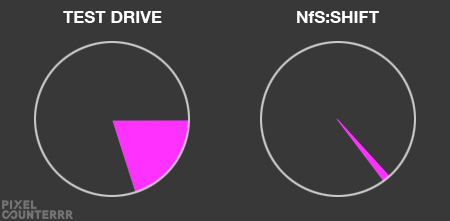
This is why, I believe, it’s irrelevant how many cars one has in a racing game when the amount of cars goes beyond some reasonable number, say, 15. The higher the number gets, the smaller the piece of appreciation pie becomes per car. I remember having so much fun playing TD with only 5 cars, because back then you really had a chance to develop a special relationship to every each of the cars, in contrast to the sea of cars found in Need for Speed: SHIFT.

In addition, people in general don’t like to make decisions, let alone when there’re tens of options to choose from. Even a child gets frustrated when she has too much toys to play with.

Naturally, I’m not by any means against a huge number of cars in a racing game. It is pretty cool to have own virtual car museum with the possibility to take every exhibit for a spin at will.

Those Hot Tail Lights

August 22, 2010

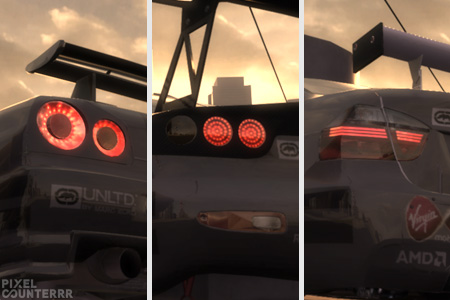
I have a special relationship to the Race Driver: GRID. I own a PlayStation 3 copy of the game with Codemasters’ signatures all over it (thanks to this animation), although I don’t own that particular console. Furthermore, I still find GRID exceptionally pleasing aesthetically in various ways, regardless of the extreme post-processing that felt a bit iffy at the beginning, and which I have criticized before.

But above all, what caught my eye right off the bat were the tail lights, and especially the supposed LED –ones. They just looked gorgeous under the darkening sky of the Yokohama docks, as if the old El Diablo himself was staring at you, spitting flames out of his exhaust-mouth.

So, the reason why the tail lights looked to me so impressive in GRID is two fold, I believe.

First, the modern LED –lights simply look cool even when encountered in real-life. LEDs usually make a car look more contemporary and in some cases, even provide this subtle touch of sci-fi (see Lamborghini Reventón).

Secondly, and more importantly, the tail lights indicate very delicately how far the texturing has come from the early days of texture mapping, in terms of resolution. If there had been LEDs in cars in the early 90s, it would have been impossible to make textures to represent them in a game; the resolution would had not just been there yet to capture all the necessary details.

So perhaps there’s a little destiny involved that LEDs appeared in cars in the time when we have enough resolution at our disposal to make textures of them.

No Shadows? Really?

August 20, 2010

The Fallout series is part of my pile of shame, excluding the (thus far) newest installment Fallout 3, and that undeniably questions my credibility as a gamer. It feels like everyone but me has played the first two Fallouts and everyone has a tale to tell about stealing kids, grotesque chain reactions, Dogmeat and so on.

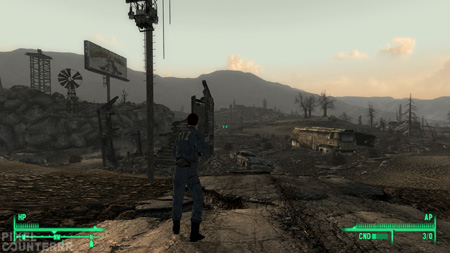
Then again, what really boggles my mind is the shadowing in Fallout 3, or the lack of it. The only real-time shadows in the whole game are the ones cast by the characters, which was unacceptable even in 2008 the game was released. And not to mention there were such games as Crysis and Call of Duty 4: Modern Warfare been released a year earlier with full real-time cast shadows.

Another lighting related problem with Fallout 3 was the one that obviously stemmed from, once again, the dynamic time-of-day –lighting. It disabled the possibility for baked (non-real-time) shadows as well, so in terms of the shadows, Fallout 3 should almost be counted as a retro-game. Interestingly there is a mod that adds ambient occlusion shadows into the Fallout 3 but not basic cast shadows.

One can only speculate the reasons why Bethesda Softworks ended up with such a solution with Fallout 3, so let’s speculate.

I believe the open-world played a huge part when designing the Fallout 3 lighting solution. Obviously there’re still big problems involved when lighting massive areas with real-time shadows, one of the biggest being the absence of area shadows. And perhaps the developer simply aimed more resources towards the actual content of the game, which there are plenty of, than the technology itself. Something like decently performing real-time shadows can drain any studio’s resources in a minute, so perhaps it was about resource management from the get-go.

All in all, at the moment, the shadow-systems can be pretty unstable when applying them to unrestricted open-world environments, let alone when the lighting is a dynamic time-of-day -one. Although Crysis pulled it off pretty nicely but it was, and still is, a PC exclusive and heavy on the hardware, while Fallout 3 was a multiplatform title. On the other hand, Assassin’s Creed 2 is a multiplatform title and it has dynamic time-of-day lighting, of which shadows, however, perform in some conditions rather poorly (I bet the situation is even worse on the consoles). AC 2 has some tricks up its sleeve though, to which I come back later.

So, is Fallout 3 ugly game then? No. There’s so much going on in the geometry (even if a bit repetitive and procedural), textures, atmosphere, and architecture that the lack of shadows can be somewhat ignored.

And it’s a decent game.

Thoughts On Hardcore

August 13, 2010

A while ago there was – perhaps rightly so – a bit of murmur when I referred to myself as a hardcore gamer. According to comments, I’m not a hardcore gamer since I’m not playing games like NetHack or other games with an extremely high learning curve. Fair enough, but I’m still having a hard time describing my relationship to the gaming in any other manner than as hardcore. But me being a hardcore gamer or not isn’t interesting in the slightest sense.

What is interesting is the notion of hardcore itself. What does it mean? For starters, the term hardcore presupposes that there is a wider, more diverse spectrum of audience in which core the “hard ones” are. Indeed, one cannot be a hardcore if there’s no softcore to compare with.

In short, my understanding of the matter is, that a hardcore is an enlightened enthusiast of a particular field of culture that is also recognized by the mainstream, which is actually the ultimate paradox of any snobbery in any field: we need the mainstream in order to exist.

If we look at the history of spectacle, for instance the Magic Lantern, the medium, or picture apparatus, itself was more than enough to attract people, therefore the show was aimed basically for every demography who were only able to take part in the event. Since then, the same has recurred every time a new medium has been introduced. It takes time for people to see pass the medium and start to demand content that is relevant to their interests, which leads to the birth of genres. At that point, the audience starts to divide and subcultures start to rise. In a way, the appearance of a hardcore audience segment is a sign that the medium in question is starting to stabilize itself, which is a good thing. And at the moment, video games are right in the middle of that process, which makes the medium so exciting.

Of course, the term “hardcore “ is completely interchangeable with the term “nerd”, but who wants to be a nerd when you can be a hardcore?

Redneck Lighting

August 4, 2010

I wrote earlier about the limited options for simulating the light when using the ray-casting technique, so on that note, there were these particular lighting (or should I say “lighting”) elements in ray-casting game Redneck Rampage, which really caught my eye back in 1997. The effect was simply amazing at the time, although I had a feeling in the back of my mind that there was something fishy about the effect, but back then, I just couldn’t put my finger on it what it was. Indeed, that was because the “lighting” effect really was nothing more than a texture painted to portray the light cone hitting the surface, and thus wasn’t really a lighting simulation at all. In retrospect, one could say fittingly that the lighting effect in question was an authentic redneck solution for the problems the aging rendering technique, ray-casting, posed.

So why those particular lighting elements in RR looked so amazing at the time (at least for me), even though Quake, released a year earlier, had technically speaking way more sophisticated lighting throughout the game and not just in elements here and there? I believe it was the context. Quake wasn’t a ray-casting game anymore but a next generation title with true 3D space, so one should have expected, rightly so, more advanced lighting model from such a game.  So when you, for instance, encountered seemingly sophisticated lighting effect in a ray-casting game acknowledging the limitations graphics engine had, the experience in a way transcended the framework through which you thought you were observing the game. Technology became indistinguishable from magic for that brief moment, as late Arthur C. Clarke would put it.

It’s always about the context and expectations, as it is with life in general.

Regarding David Jaffe

July 31, 2010

If you had to single out only one game developer who’s still currently active, I’m pretty sure Eat Sleep Play’s David Jaffe would be it for many of us following the industry. But why is that? Jaffe’s track record is short but strong (God of War –series being the most known accomplishment) but not that strong. Still Jaffe sits in every other panel discussion and gets interviewed a lot more often than his peers, at least it seems like it.

My view on Jaffe is based on a very limited knowledge that I have of him, but either way, there is this one thing that comes across which elevates him in my mind above many other so-called celebrity game developers. The thing is, he hates bullshit and rebels actively against it. He really does, and sure, it can have its short-term disadvantages, but in the long run, I think it has been a major reason why he is so loved and respected among the peers, press and audience. Jaffe receives so much love and good will – which he deserves – from the industry that it’s almost silly, and I believe Sony acknowledged that and gave Jaffe for that very reason a special treatment at their E3 2010 press conference. Sweet Tooth delivered, but how about the new Twisted Metal? We’ll see.

Ok, Jaffe do have other qualities too that I for instance would love to possess, such as determination, playfulness, down-to-earthness and most of all, genuine gratefulness for silly things like the God of War –branded Slurpee. It would be hard to see Jade Raymond to go nuts over an Altair Slurpee on her video diary, wouldn’t it?

I truly believe bullshit can take you only so far, even if it can have some short-term benefits. However, I’m afraid that Jaffe is in peril to go overboard with his straightforwardness. To label and brand oneself so aggressively as an avid bullshit-denier can become self-delusional (and thus, bullshit) in itself in the long run, if not careful.

Maybe some bullshit is necessary after all.

Virtual Set, Real Problems

July 29, 2010

When making the I Shot The Sheriff -post, I came to realization that it’s not always as straightforward as one would think to operate in virtual setting. As we all know, in real life, doing something creative on location can be a mess when dealing with so many variables, in contrast to controlled studio environment. So, when I was up to snap some screenshots inside the realm of Grand Theft Auto IV to illustrate my point in said post, those “on location variables” really did came into play, since GTA IV simulates brilliantly various real-life phenomena.

First of all, I knew I wanted a police car so I had to first find one and not to mess it up before shooting it (in more ways than one). So, I did the obvious and called 911 with my cell phone and then stole the police car arriving at the scene, which is seldom an easy task to do without taking a few hits here and there. Of course at this point you can go and park it in front of the safe house and save.

Secondly, I had to find a place where to park the car so I could take a screenshot from a good angle. This was a lot like real-life location scouting.

Thirdly, there was a dynamic time-of-day –system to take account, so I had only so much time to take a screenshot in proper lighting. It was almost stressful trying to take a good screenshot when you constantly saw the sun going down and the shadows moving, given that you can’t save at will in GTA IV and just quickly reload the situation. This time-based lighting is a constant problem in film industry when shooting on location.

Fourthly, when everything else was set and ready to go, I had to then shoot the car with the shotgun to get the holes I needed, which naturally raised curiosity of the nearby police almost every time. So, at one point I was struggling to take a screenshot from a proper angle basically in a bullet storm coming from the police, my blood splattering all over the place at the same time. Ok, this wouldn’t be so much a real-life problem but it can be seen analogous to otherwise distracting bystanders on location.

Virtual is by definition something speculative and not real, so in theory it should be free from real-life constraints we experience daily basis. However, in my case, it thought it would have taken more effort from me to get rid of those constraints by hacking and using cheats than dealing with them, but I may have been wrong. In any case, I still didn’t feel genuine irritation or frustration at any point, but quite contrary.

I felt “I really love this medium.”