That Pixelation Effect

October 3, 2010

One of the most fondest memories I have towards gaming must be the one summer day when my big brother and I played Narc (in free-play mode) for the first time at the arcade of a certain theme park we visited every summer back in the early 90s. The premise of the game was basically “Miami Vice on steroids”: two cops, white and black, cleaning up the streets using a sports car (equipped with machine guns) as transportation.

Narc was cool, brutal, had an attitude, and above all, absolutely beautiful to look at with all the digitized sprites and smooth animations. And that gruesome violence that gave a whole new meaning for war on drugs was something novel back then. Using the rocket launcher never got old, one of the reasons being the gorgeous smoke trail it left behind.

And furthermore, it had this cool transitional pixelation effect in it when the criminals were “indentified” on a computer screen at the beginning of each level. It lasted only about a second, but it made a lasting effect on me nevertheless.

So, after playing Narc in that arcade a few hours, it became something as an obsession to me to have somehow that same exact gaming experience in home environment, and I ended up actually buying the Sega Mega Drive (Sega Genesis in North America) for that very reason.

Remember those Sega ads with “true arcade experience at home” –promises? I sure do.

Only later I learned that games were in fact far from arcade perfect conversions, but compromised and downgraded versions of their arcade counterparts, and as a cherry on top Narc, the main rationale behind my Mega Drive purchase, wasn’t even available on that platform in any shape or form, which broke my heart a little.
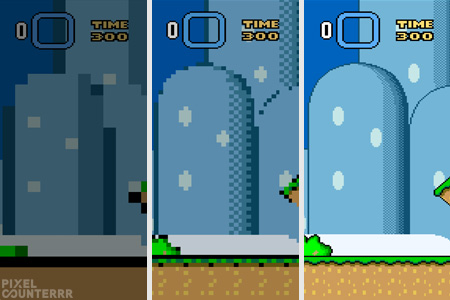
But when I saw Super Mario World running on Super Nintendo at a gaming store and it had in it that same exact pixelation effect I had saw in Narc, something moved in my chest. This could be it, the ticket to the Narc –experience I had waited for so long.

Later I did sold my Mega Drive and bought Super Nintendo to replace it, but not so much anymore for the hopes for Narc – I had already given up that idea a while ago as unrealistic – but for the Super Nintendo’s more advanced hardware that was capable for so much more, such as the pixelation effect. Still, the effect in question took me many times back to the moments of me and my bro playing Narc in that arcade, and at the same time, made me ponder the slightest possibility for Super Nintendo version of Narc, which, of course, never happened.

People often pursue to recreate things from their past that are just not recreatable. Moments in time are sums of infinite variables, and trying to recreate those moments to happen again is a doomed task. When trying to do so, it’s feasible to address only so many of the contributing factors. So, even if I’d managed to acquire somehow an arcade perfect Narc into my home back then, it still wouldn’t necessarly have brought back that feeling we had at that day, me and my bro playing the heck out of that game in that arcade.

We have to cherish the moments as they are happening, since when they are gone, they are gone for good.

The Problem Is Freedom

September 23, 2010

In an earlier post, The Problem Is Choice, I contemplated the concept of sweet spot, and how the player can choose to experience the real-time image in a way the developer, the author, would never have wanted the game to be experienced. This freedom of choice is exactly the reason why Roger Ebert says that video games can never be art, and I partly agree with him; art is too limiting and degrading label to the real-time image which is so much more.

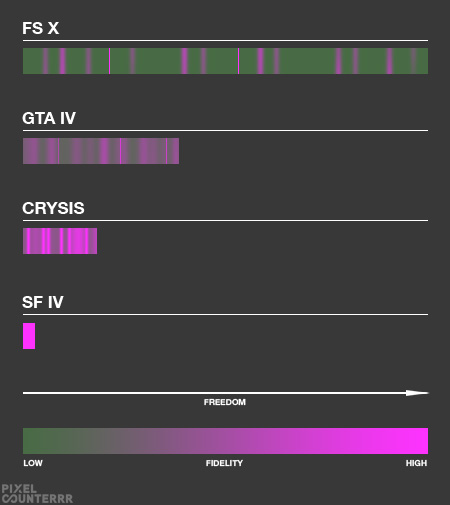
As a continuation to that post, I started to think how the amount of spatial freedom the player has in any given game, relates to the visual fidelity of that game. It seems that high level of freedom results in either low fidelity all over, like in Minecraft, or highly uneven fidelity, like in Microsoft’s Flight Simulator X. In FS X the planes and cockpits are top-notch, but the scenery at large is dull and mostly repeats itself, excluding the particular landmarks, like the famous airports or certain parts of iconic cities. FS X is an example of a game with ultimate freedom that comes with the price of ultimate incoherence.

If we then look at the other end of the spectrum, like Street Fighter IV, the fidelity in SF IV is as high as it can get, universally, thanks to the extremely limited spatial freedom of the player (and thus of “the camera”). It’s hard to take a bad screenshot of SF IV, even if you tried to do so, in contrast to FS X.

In a way, it’s sad that the child-hood’s fantasy of “a game where you can go anywhere in the world and do anything” isn’t going to happen, not on our lifetime at least. Of course, one can create infinite worlds using procedural techniques, but procedural is never equal to the stuff that is made by design. I’m really not a big believer in procedurally generated content, but in some limited cases, it has its place, for sure.

As the friends across the pond use to say, freedom is not free.

Are We There Yet?

September 19, 2010

Drawing with the Commodore 64’s classic Koala Painter wasn’t the easiest task to do; joystick as an input, lots of crashes, pixels as big as Lego-bricks, and not to mention, a highly limited color palette. In fact, everything else was somewhat tolerable and forgivable, even the crashing if you just knew what procedures to avoid, but you just couldn’t get around with the poor amount of colors that was available. And because the resolution was equally poor, rasterization techniques were essentially ruled out from the get-go due to the hideous results.

Luckily, color palette has since then increased steadily from C64’s 16 colors, to modern hardware’s millions of colors. What this transition has caused by and large is that the number of colors has become basically a non-issue in contemporary mainstream real-time imagery discourse, as if the whole project of colors would be concluded. And it essentially is, since the 16,7 million color palette has been a consumer standard for years now, and obviously “good enough” for majority of people.

So, I started to think what else has come to its evolutionary end in the realm of real-time imagery, and one instance I could think of was screen resolution. I’m highly skeptical that there will be a demand for higher than 2560 x 1440 resolution (which is the resolution of a typical 27” display for professional use) in near future, since even 1920 × 1080 (Full HD) has been something of a gold-standard for quite some time. And bigger resolutions would entail bigger displays, which is hard to imagine happening in home environment for logistical reasons alone, given the enormous physical size of today’s flat-screen TVs.

Ok, I really didn’t see the iPhone 4’s Retina Display coming, but I guess only few of us did. The Retina Display’s resolution is far beyond the reasonable need, so it’s rather safe to declare that the pixel-density has now officially hit the ceiling, or at least is about to hit in the very near future.

As said, color palette and resolution haven’t been issues for a while now, which gives rise to the question when do we have, for instance, enough onscreen polygons ? Or when lighting is “good enough”? Perhaps I’m comparing apples to oranges here, since palette and resolution are more directly dependent on the technical features of hardware, than number of polygons or quality of shadows. Still, it would make sense that there will be a day when we aren’t anymore discussing polygons or shadows per se, but solely the artistic use of them. The technical discourse becomes obsolete.

In a way, I really don’t want to see that day, since the chase is always better than the catch.

Really Smooth

September 13, 2010

If someone would come up to me and asked what is the single most important aspect of the real-time image from the aesthetic point of view, I would say frame-rate. Without blinking an eye. It’s so important that I’ve uninstalled a game only for the fact that it was arbitrarily locked in 30 frames per second, a decision that made little sense to me.

Interestingly, frame-rate hasn’t always been an issue in video games, and I believe the discussion of it really fired up with the introduction of simulated z-axis, that is the 3D graphics. The thing was, even the most rudimentary 3D was such a struggle to the early days’ hardware, likes of Commodore 64 and Amiga 500, that it took relatively long time before one could see fluent 3D in a home environment without all the rendering errors and hick ups. And I’m not only talking solely about polygons here, but other methods to depict z-axis, too.

That been said, one could only imagine the pure bliss that was to see completely smooth frame-rates in arcade-games, like Outrun (1986) or Chase H.Q. (1988), back then with, I’d say at least, 40 frames per second sprite scaling. As a matter of fact, it was exactly those games that taught me the value of high and steady frame-rate, and how mesmerizing it really can be to see an image simulating the z-axis so smoothly in real-time.

So, I believe it was not until the 3D hardware acceleration revolution in the late 90s that truly changed the paradigm for frame-rate in a way that people started to expect smooth frame-rates from games in a home environment. Seeing Jedi Knight: Dark Forces 2 (1997) rolling on a 3Dfx Voodoo –card in our home PC for the first time with no stuttering whatsoever, was something that I will probably never forget. In fact, most of the jaw dropping experiences in general have usually been related to high frame-rate, in one way or another.

Now that frame-rate in real-time imagery is steadying in about 60 frames per second, it’s funny how old mediums, like film or television, are still pushing only 25-30 frames onto the screen per second. It baffles me why film industry is concentrating to the obnoxious 3D technology, and totally ignoring the very problem (besides the mandatory and horrible glasses) why the contemporary stereoscopic 3D is failing: the low frame-rate. James Cameron acknowledges that, but apparently that seems to be not nearly enough.

All in all, frame-rate is in the core of real-time image, and if it fails to deliver, everything else falls apart, in my mind. That is especially true in modern games. There really are no excuses for bad frame-rate, at least ones that I’d be okay with.

Lynch & Lynch

September 8, 2010

I find Kane & Lynch –franchise extremely interesting for various reasons, not the least of which is the well-carved and unique characters. As we all know, gaming industry suffers of so-called Matt Damon –syndrome, which means most of the (male) characters simply look too clean, generic, and healthy.

That been said, it came as a surprise how much the characters’ appearances had changed from Kane & Lynch: Dead Men (2008) to Kane & Lynch 2: Dog Days (2010), especially the Lynch –character. One would think that the developer would focus on the recognizable characters, considering how much the Kane & Lynch -franchise relays on them. And I’m not talking about only the shape of sunglasses, the clothes, or the facial hair, but the whole underlying facial features and bone-structure.

First Lynch looks unmistakably like a real bad ass, even without the beard and accessories. In contrast, the second Lynch from the sequel looks a little wimpy to such extent that it’s almost comical. Naturally, you don’t see Lynch stripped down like that in any point of the game, but still, the dissimilarity affects the overall look and feel of the character, there’s no question about it. And what makes it even weirder is that there’s no technical reason for not using the same geometry in both games, since they basically belong to the same generation, meaning the polycount is consequently similar in both models. In fact, geometry found in back of the heads including the ears are identical, so obviously the first Lynch -model has functioned as a basis for the second one, after all. Or they both just share the same proto-model.

Ok, there are franchises, such as James Bond, in which the actor, and thus the protagonist’s appearance, has changed multiple times over time, but there’s always been good reasons for it, say, aging, for one. But those issues are non-existent in the realm of real-time imagery, since geometry stays the same no matter how much time goes by.

Interestingly, another character-centric series Max Payne did use completely different characters in the first and second installments, which I really wondered at, back then. However, I recall writer Sam Lake saying that he just didn’t want to provide his face anymore, and wanted to give a change to a professional actor to do that. I really liked the original Sam Lake-Max, though.

So, choose a character and stick with it.

Born In 1980

September 3, 2010

It is fair to say that the best thing the 80s ever had to offer people, was the possibility to be born in it. I’m not saying 80s was a particularly bad decade, but it definitely had its dark moments, which we don’t have to go into detail.

From the perspective of real-time imagery, the 80s, and especially the early 80s, really was the best era to be born in, if you just happened to be interested in computers and such. And I, for instance, learned quickly that I was.

To be born in 1980 means that I have an optimal vantage point, which covers the most crucial developments, the Cambrian Explosion, in the history of real-time imagery, starting from the release of Commodore 64 in 1982. I consider C64 as a tipping point after which strive to graphical excellence in home environment really started happening. “But you were only two years old when C64 was released”. Yes, but our family got the C64 not until 1984, so the decent software was already there, just waiting to be played with. So I had only lived four years without any exposure to real-time imagery whatsoever, four years of which I can’t remember a thing. But I remember clearly the first time when I saw Pitfall II: Lost Caverns running on C64 in the Christmas of 1984.

This means that the evolution of real-time imagery is an integral part of me growing up, and of my very being. I have the privilege to be watching real-time medium to evolve up close, of which future researchers can’t be anything but envy. It’s like being an Egyptian watching the pyramids being built.

The 80s wasn’t so bad place to be in after all.

Three Green Lights

August 29, 2010

I highly doubt that the original Tom Clancy’s Splinter Cell developed by Ubisoft Montreal in 2002 was the first game to use sophisticated real-time point-light shadows, but I remember it back then being the first one in which I personally saw them in action. I was truly impressed by the shadows thinking “this is something completely new and subversive”. And those moments are the sole reason why I am (and everyone else should be) following the real-time image industry in the first place.

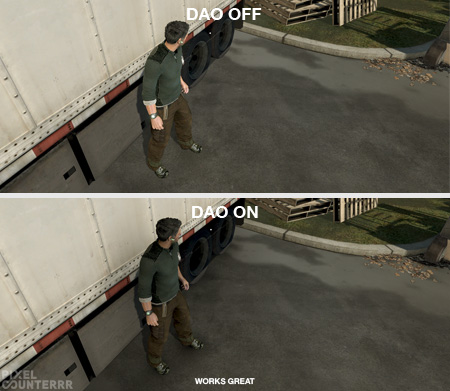
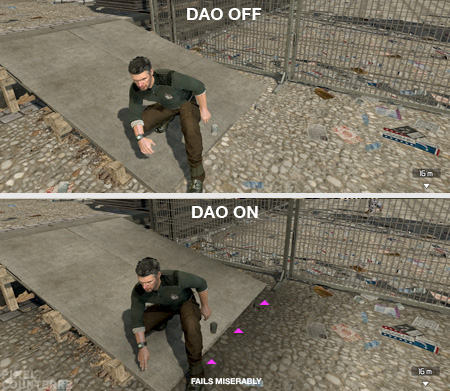
On that note, I find it fascinating that 8 years later I had almost the same exact experience with the newest installment of the same Splinter Cell –series, Tom Clancy’s Splinter Cell Conviction. Obviously, I’m talking about Conviction’s unique Dynamic Ambient Occlusion (DAO) system which is something I had never seen before in a real-time / video game context. And make no mistake about it; this is not a post-processing effect, like the Screen Space Ambient Occlusion (SSAO) found in Crysis and alike is, but a view-undependable, spatially genuine shadowing system, and one can only wonder how in the world Ubisoft Montreal pulled it off so neatly.

Of course, Conviction’s DAO is far from perfect and it seems to have a rather narrow sweet spot in which it performs best, due to the mainly relatively large scale of the effect. And there are some inconsistencies too, and downright errors. But still, I’d take it over SSAO anytime, anywhere.

What is the impact on performance then, you may ask? In the case of Conviction, it’s hard to tell precisely since Conviction seems to be not so well optimized as a whole. It stutters more or less with and without the DAO on my setup on which majority of the modern titles work otherwise fine. However, according to the developer, the performance hit should be somewhat equal to of SSAO, which is not a major issue.

All in all, in my opinion, it cannot be stressed enough how big of a deal Conviction’s DAO is. Indirect illumination is somewhat like the Holy Grail of real-time imagery, and this is a huge step in a right direction.

When do we see the next step?