Unnecessary Polygons

December 13, 2010

I have always had warm feelings towards polygons as pure forms, even (or especially) back when they were such a scarce resource that one could literarily count the number of onscreen polygons – a task which often low frame rate made quite feasible to undertake. There is some elegant, cold beauty to be found in old-school flat shaded polygons, and a game like Virtua Racing still looks in a way as absorbing as it did back in the day.

Obviously things have changed since, and today polycount isn’t considered as a major issue any more within the real-time medium. And the use of polygons aren’t limited only in flight simulators and such either, like in the early days, but are been employed across the genres. In fact, polygon-based imagery has become so mainstream and mundane that polygons go generally unnoticed in these days: they are simply the stuff what everything is made of.

That said, an interesting pheonemon happened when I fired up Reckless Racing on my iPod Touch one day. The geometry in that game really jumped out of the scenery, even though the game wasn’t supposed to be all that three-deey in the first place, but rather resembling an old-school top-down racer. For instance, the extra-tall churchtower appeared really impressive on the screen when driving past it, which got me thinking what actually made that seemingly generic geometry so special?

Let me tell you.

I believe the reason lies in the 2D gameplay itself, meaning the game could have been carried out in theory without using a single polygon, like they did in the ol’ days. The thing is, any game using, for instance, a first-person-view needs some sort of a 3D engine to work out even in theory, since the gameplay operates usually in all three axes (the z-axis is actually the key issue[1]). But games with strict x and y –axes (2D) gameplay, such as RR, don’t require a 3D engine to be fully functional, thus in a way polygons are there solely as luxury items without any genuine need or purpose in terms of the gameplay. And the church tower in question was obviously the pinnacle of that excess-ness and unnecessary-ness that for some reason fascinates me. Or what fascinates in luxury by and large, I might add.

Additionally, part of the aesthetic charm must stem from the disorientation the visual muscle-memory of hundreds of sprite-based 2D games with a similar perspective causes to one’s brain. Perhaps the mind projects now-obsolete limitations on top of the 3D imagery and acts surprised when the fantasy limits are suddenly “broken” by polygons sticking out of the ground.

Of course, there are number of similar cases which fascinate equally, like Street Fighter IV and Bionic Commando Rearmed to name but a few. The latter even includes completely unnecessary, but beautiful, ragdoll physics as a bonus.

[1] For instance, Wolfenstein 3D operates only in two axis: x and z, but needs a 3D engine because of the z -axis.


Back Off

December 2, 2010

I wrote earlier about the problems the freedom of choice poses on real-time medium, and how every video game has a sweet spot in which it looks optimal. Polyphony Digital, the developer of the Gran Turismo series, CEO Kazunori Yamauchi must have read that piece since in the newest installment of the series, Gran Turismo 5, the game takes arbitrarily and without any subtlety a portion of that freedom away from the player – a decision motivated by vanity and fear.

See, in certain conditions, GT 5 politely instructs the player to move away from the car before “taking a shot” in the otherwise gorgeous and print-quality-images-producing photo mode. GT 5 is acting like a bodyguard pushing paparazzi away from a declining star who just couldn’t fade away with dignity.

But why on earth GT 5 would pull a stunt like that?

One part of the reason stems definitely from the crazy “over thousand cars” premise, which inevitably led to the standard-premium division, making majority of the car rooster look like something out of Playstation 2, or even a generation earlier. Yes, it’s indeed the standard cars of which GT 5 doesn’t allow people to take pictures up close, which amusingly gives away the fact that even Yamauchi himself acknowledged that there was something fundamentally wrong with putting low-definition assets in a Playstation 3 game with a highest profile to so far.

Second part of the reason can be found from the mere existence of the Internet. Without the Internet, Yamauchi wouldn’t have had any problem whatsoever with people taking unflattering screenshots of his game for their own enjoyment. But thanks to the Internet, no stone is left unturned (and unshared in the age of the Net) when the hardcore audience starts dissecting every possible flaw the much-hyped game may or may not contain. Kill your idols, and so forth.

It’s interesting to see if this kind of screenshot-limiting becomes more of a standard in the future, where developers may turn more paranoid of how their game will appear in screenshots posted in hardcore forums, like NeoGAF. It’s common knowledge that gaming press even today receives strict guidelines from publishers if some poor soul wants to use manually taken screenshots as an illustration, and my understanding is that for that very reason reviewers often end up using glossy PR-shots purely out of convince.

Of course, in the PC side of the gaming, such limiting endeavors would not go far, but as the gaming by and large is constantly drifting towards walled-garden approaches, like gaming consoles and AppStores, a developer-dictated screenshotting could indeed become a valid scenario somewhere down the line.

But let’s hope not.

*Playing* With Games

November 25, 2010

One quite popular strategy to criticize a video game is to label it as a glorified tech demo of some sort. I get that sentiment, but still, it comes across a bit funny from the perspective that I actually love tech demos, or  at least the core idea of them.

The thing is, tech demos often condense and encapsulate the essence that ultimately makes the whole medium tick and stand out from the traditional media. It really is the technology, tech, which remains left when everything else is stripped down, and it’s nothing short of exhilarating to watch every time when a developer brings something novel, or in the best case scenario groundbreaking, technology to the table, using a tech demo.

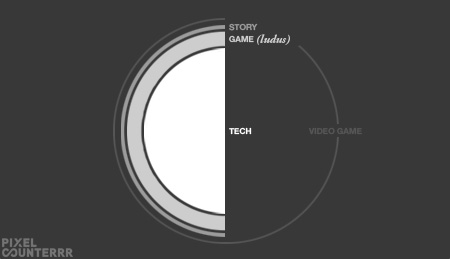
But before we go any further, we have to look into how Roger Caillois divides act of playing into two separate concepts, which he calls ludus and paidea. Ludus refers to the type of play that contains rules and goals, whereas paidea is something that a small child performs spontaneously, without having any specific objectives or rules in her mind.

So tech demos by definition lack the element of ludus (and story) altogether, which supposedly makes them boring and pretty much pointless endeavors. However, the mode in which I have played video games the most throughout my life actually resembles more paidea type of playing than ludus, which in a way makes my relationship to video games as that of tech demos to an extent. I play with them like a child plays with his or her toys.

Yes, I have no problem admitting spending hours playing only with shadows in Crysis, rotating 3D models in Starglider 2, and messing around with the Euphoria engine in Grand Theft Auto IV. Of course, it takes some level of childishness to allow oneself to behave that way, but isn’t that what video games are all about?

Waiter, There’s a Vertigo In My Game

November 18, 2010

Alfred Hitchcock left his mark on the language of cinema, there’s hardly a question about it. One quite popular effect that Hitchcock introduced to the filmmaker community was so-called Vertigo effect that was used for the first time in the movie with the same title, Vertigo, when the main character suffered from lightheadedness caused by fear of heights. The Vertigo is carried out by zooming the camera in at the same time (and rate) as it is physically rolled away from the object, thus creating an illusion of shifting depth of space. Obviously, the effect works the other way round as well. Since  the movie Vertigo, the effect has been used so much that it has became a movie industry cliché and sort of an inside joke.

The charm of the Vertigo is in its ability to seemingly distort reality, making it useful depicting dizziness, dramatic emotions, and even mental illness. So, the keyword really is here “distort”, meaning it renders reality in a very unnatural fashion that is outside of our day-to-day experience. In cinema, this kind of reality-interpreting artistry is okay, and only seldom can be seen as problematic. That’s what cinema is all about!

In video games, though, it’s a different story.

The thing is, the viewing paradigm in video games is fundamentally different than the one in cinema, which comes actually back to the earlier discussion of how video games are based on simulation whereas cinema is on narrative. As simulation replicates the looks, and more importantly, the logic of how the reality fundamentally behaves, such reality-distorting (or counter-reality) effects as the Vertigo break that established relationship between the viewer and the simulation, i.e. video game. Zooming alone doesn’t do that since zooming is part of our common perceptual experience via binoculars etc., but the Vertigo isn’t. It’s completely alien concept.

So, if video games are to simulate our perception of reality, those “cinematic” approaches do nothing but harm to the experience. Of course, in cut scenes everything goes, but I don’t consider them as a part of the paradigm of video game anyway. On a side note, I still find it funny how cinema is seen as some kind of benchmark against which video games should be measured, even though the whole comparison is inherently broken for the reasons explained above.

Examples of the Vertigo effect can be found everywhere in modern gaming. For instance, in Assassin’s Creed when performing the Leap of Faith, camera does the Vertigo, obviously aiming to exaggerate the height (and the drama) of the jump. But instead, not only that it feels wrong and out of place, it simply destroys the “realness” of the height by distorting the depth perception. Put differently, the simulation breaks down.

Also many arcadey driving games, like the Flatout –series, do the Vertigo when using “nitro”, which takes actually away the sense of speed for a moment, making the situation quite ironic.

In short, I have yet to encounter a case in the realm of video games, in which the Vertgo would have worked in favor of the game. It’s just a cheap and disfunctional trick, which shouldn’t have a place in video games.

In movies and cut scenes, it’s okay, I guess.

Epic Castle

November 3, 2010

The original Unreal developed by Epic Games back in 1998 really was the second time when I was genuinely blown away by the mere visuals of a video game in home environment, first one being Doom in 1994. I believe Unreal was back then one of the first games to take every bit out of newly released 3DFX –card: Sophisticated lens flares, colored lights, dynamic reflections on some of the floors, multi-layered textures, volume fog, and so on. And not to mention the moment when I stepped outside of the ship and saw the breathtaking skybox with moving clouds for the first time, I’ll never forget that.

But as a game, Unreal was deemed as a glorified “tech demo”, and I have to agree with that to some extent. In fact, the demo at the Unreal’s start screen, in which the camera flew around this castle, demoing basically everything the engine had on its sleeve, was almost enough for me to get satisfied with.

So, does this sound any familiar?

Yes, Epic pulled off the exact same thing earlier this year when Cliff Bleszinski presented Unreal Engine 3 on iOS with Epic Citadel –technology demo at the Apple event. People, including me, couldn’t believe that the castle in Epic Citadel really was rendered in real-time on a tiny handheld device that iPhone/iPod Touch is, it simply looked too good to be true. But it was.

I think Epic Citadel is an interesting case in many sense.

First of all, it amazes me how Epic provided me almost the same exact sense of wonderment with two different titles 12 years apart, given the rapid progression of the industry. Ok, id Software has no bad track record either, but it breaks my heart to ask how relevant id actually has been lately? [update: RAGE HD on iPhone looks pretty awesome] Epic has become almost a synonym for high quality graphics, and such breakthrough titles under its belt like Gears of War, besides being the best looking title of its time and giving birth to a genre, really have proved Epic’s worth.

Secondly, Epic Citadel’s technology is out of this world. Of course, I’m saying this only because of the platform on which it is, but nevertheless, it’s pretty amazing that we can now run graphics on a device this small that are in some sense on par with of Half-life 2. And the fact that Epic Citadel uses a technology called relief mapping that renders some of the textures in pseudo 3D, which HL 2 lacked altogether, blows my mind the most.

Ok, Cliff Bleszinski could use some medium size t-shirts for a change instead of those extra small ones, I’ll give you that.

Mixed Shadowing Arts

October 27, 2010

Apparently, Mixed Martial Arts is huge at the moment, surpassing even the boxing according to some, and yes, the premise sounds great in the paper. In reality, though, matches often reduce to the lowest common denominator, and the fighters end up spending most of the time wrestling each other out against the cage, huffing and puffing. Interestingly, fever rules tend to lead to less interesting results, just like in arts in general.

So, Mixed Martial Arts as a sport is one of those cases that work better in a simulated form where there is some actual combating taking place.

However, what really makes these types of games interesting are the ultra challenging and unforgiving lighting conditions where there are supposedly hundreds of distinct lights illuminating the arena from almost every conceivable direction. And that’s a pickle.

EA Sports MMA’s offering as a solution for this classic problem can be described as peculiar, to say the least. The thing is, the opacity of the shadows in ES MMA depends on the distance they are in from the shadow-casting object, in the spirit of area shadows, but not quite. This applies to a certain height (around the knee) beyond which the gradient shadow is completely replaced with evenly blurred one. Notice the obvious threshold separating the two different types of shadows.

The shadows in ES MMA noticeably work best when the fighters are standing up, and conversely get really unnatural and weird when the action gets down on the mat, which is more apparent in motion. On a side note, the logic of how the shadow effect is rendered actually resembles a lot how z-buffer behaves.

Interestingly, prior released UFC Undisputed 2010 has a totally different approach to the same issue that is basically the scattered shadows. UFC combines couple of extra shadow maps per fighter with simple but effective ambient occlusion –effect that kicks in when ever something approaches the floor. UFC’s solution for shadows works like a charm and is far more consistent (and realistic) than the one ES MMA throws at you. A beautiful solution is beautiful.

It’s always intriguing to compare two different approaches to a given problem. ES MMA’s offering is a bit mix and match, and downright bizarre, while UFC pulls off the shadowing with flying colors, given the limitations of the current-gen console hardware. Perhaps the developer of ES MMA EA Tiburon didn’t have for some reason a decent ambient occlusion algorithm at their disposal, and thus ended up doing something rushed and unintuitive.

Either way, both games are great, at least so I have heard.

End of Story

October 19, 2010

I remember the time when gaming journalists started their reviews by summarizing the background story, and yet, being aware to some extent of the ludicrous nature of such concept as stories in video games. Perhaps people knew back then better (or just were intellectually more honest) that it really didn’t make a whole lot a difference what the motivation supposed to be behind given sprite to travel left or right killing everything.

But then someone had an idea that video games as a medium must be taken more “seriously”, just like movies do, and apparently investing on the story and the characters is seen as the ticket for that. In effect, there emerged a pressure for developers to incorporate more thought out characters, compelling stories, and engaging plots into their games with variable success.

The problem, however, was and still is that developer simply can’t force the player to choose according developer’s will, and because stories consist of usually characters making decisions about their lives, interactive (scripted) story is nothing but an oxymoron. And because video games’ very core has everything to do with interactivity, there really is no way around it.

Gonzalo Frasca lays down a compelling argument that video games are based on a semiotic structure known as simulation,

which is a way of portraying reality that essentially differs from narrative. […] Simulation does not simply represents objects and systems, but it also models their behaviors.

I believe Frasca’s stance is the key in understanding why scripted story and pre-designed characters are in conflict with the very nature of video games. The thing is, video games don’t just show you stuff, they let you do stuff, and video games should therefore first and foremost provide best possible means and environments for doing so through simulation. And what’s cool about simulation is that it allows people to do and experiment things safely without ethical, economical or any other kind of repercussions whatsoever, which ultimately makes video games unique among the visual mediums.

Indeed, I happily admit playing Grand Theft Auto IV from start to finish by having only a vague concept of the overall storyline, but still enjoying the gaming experience nevertheless. GTA IV is a game with highly simulated environment, which enables it to generate thousands of micro-stories on the fly when one is playing the game outside of the written storyline. It’s almost needless to say that those unique “happy accidents” that take place when wandering off the designated trail are usually the most exciting and hilarious events of the whole game, and the situations where the medium manifests itself most genuinely – at least in my mind.

I really can’t help but feel uneasy when someone speaks video games as a platform for telling stories. Playing a video game for its story is like watching a movie for its editing: both of them are mere structural devices for something more profound, and in themselves quite meaningless. In movies, editing serves the story, but in video games, it’s the simulations (shooting, driving, fighting, flying, whatever) that in the end of the day count, not the story that excuses them.

Okay, Heavy Rain was a great piece of entertainment that had an emphasis on compelling scripted story, but was Heavy Rain more like a glorified “choose your own adventure” –book than an actual video game? Were there any non-scripted events to be found in the game at all? No?

This may seem harsh but in my mind all this story-character -nonsense is basically conducted in order to impress the outsiders who don’t and won’t get the real-time medium in the first place.

So, who are those people whose expectance we seek so desperately?