Archive for the ‘Medium’ Category

Thoughts On Hardcore

August 13, 2010

A while ago there was – perhaps rightly so – a bit of murmur when I referred to myself as a hardcore gamer. According to comments, I’m not a hardcore gamer since I’m not playing games like NetHack or other games with an extremely high learning curve. Fair enough, but I’m still having a hard time describing my relationship to the gaming in any other manner than as hardcore. But me being a hardcore gamer or not isn’t interesting in the slightest sense.

What is interesting is the notion of hardcore itself. What does it mean? For starters, the term hardcore presupposes that there is a wider, more diverse spectrum of audience in which core the “hard ones” are. Indeed, one cannot be a hardcore if there’s no softcore to compare with.

In short, my understanding of the matter is, that a hardcore is an enlightened enthusiast of a particular field of culture that is also recognized by the mainstream, which is actually the ultimate paradox of any snobbery in any field: we need the mainstream in order to exist.

If we look at the history of spectacle, for instance the Magic Lantern, the medium, or picture apparatus, itself was more than enough to attract people, therefore the show was aimed basically for every demography who were only able to take part in the event. Since then, the same has recurred every time a new medium has been introduced. It takes time for people to see pass the medium and start to demand content that is relevant to their interests, which leads to the birth of genres. At that point, the audience starts to divide and subcultures start to rise. In a way, the appearance of a hardcore audience segment is a sign that the medium in question is starting to stabilize itself, which is a good thing. And at the moment, video games are right in the middle of that process, which makes the medium so exciting.

Of course, the term “hardcore “ is completely interchangeable with the term “nerd”, but who wants to be a nerd when you can be a hardcore?

Virtual Set, Real Problems

July 29, 2010

When making the I Shot The Sheriff -post, I came to realization that it’s not always as straightforward as one would think to operate in virtual setting. As we all know, in real life, doing something creative on location can be a mess when dealing with so many variables, in contrast to controlled studio environment. So, when I was up to snap some screenshots inside the realm of Grand Theft Auto IV to illustrate my point in said post, those “on location variables” really did came into play, since GTA IV simulates brilliantly various real-life phenomena.

First of all, I knew I wanted a police car so I had to first find one and not to mess it up before shooting it (in more ways than one). So, I did the obvious and called 911 with my cell phone and then stole the police car arriving at the scene, which is seldom an easy task to do without taking a few hits here and there. Of course at this point you can go and park it in front of the safe house and save.

Secondly, I had to find a place where to park the car so I could take a screenshot from a good angle. This was a lot like real-life location scouting.

Thirdly, there was a dynamic time-of-day –system to take account, so I had only so much time to take a screenshot in proper lighting. It was almost stressful trying to take a good screenshot when you constantly saw the sun going down and the shadows moving, given that you can’t save at will in GTA IV and just quickly reload the situation. This time-based lighting is a constant problem in film industry when shooting on location.

Fourthly, when everything else was set and ready to go, I had to then shoot the car with the shotgun to get the holes I needed, which naturally raised curiosity of the nearby police almost every time. So, at one point I was struggling to take a screenshot from a proper angle basically in a bullet storm coming from the police, my blood splattering all over the place at the same time. Ok, this wouldn’t be so much a real-life problem but it can be seen analogous to otherwise distracting bystanders on location.

Virtual is by definition something speculative and not real, so in theory it should be free from real-life constraints we experience daily basis. However, in my case, it thought it would have taken more effort from me to get rid of those constraints by hacking and using cheats than dealing with them, but I may have been wrong. In any case, I still didn’t feel genuine irritation or frustration at any point, but quite contrary.

I felt “I really love this medium.”

Need For Cockpit

July 10, 2010

I’ve always been an avid fan of the first-person view. It just feels so natural way to experience the game world that it makes one think, why there are any other views available in the first place. Of course, I recognize the usefulness of other types of views, like the third-person view, and I very much enjoy playing some more arcadey games from that perspective, there’s no question about it. But whenever I’m playing a game which strives me to feel “being there”, like simulations often do, it’s my demand that there’s a first-person view available, at least as an option. It bugs the hell out of me when in Crysis viewpoint suddenly jumps into the third-person when entering a vehicle. Concerning that, I have to give the Official Honorable Mention to Far Cry 2 for its categorical use of the first-person view in whatever player is doing, even though as a game it didn’t do much for me.

However, this is not about above mentioned games, or their deficiencies, but about first-person view particularly in racing games.

When Polyphony Digital’s Gran Turismo 5 was demoed for the first time few years back to the wider audience, it was the same exact moment in history when gaming industry came to realization that, from then on, cockpits in racing games have to be taken seriously. That GT 5 -demo simply destroyed the competition that was out there at the time, and in a way, still does.

So, even though GT 5 looks gorgeous when driving from behind the wheel (judging again from the videos and screenshots), I would consider Slightly Mad Studios’ Need for Speed: Shift as the first first-person driver. NfS:Shift models effects of high-speed and the g-forces the driver is experiencing like no other driving game by blurring, shaking and tinting the screen. And even the HUD reacts accordingly to the collisions and everything, which is pretty crazy if you think about it.

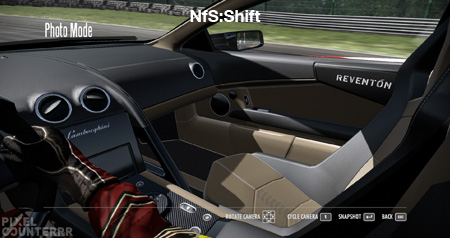
But the biggest selling point of NfS:Shift and the justification for its existence are the marvelous cockpits. The look and feel of the cockpit-view in NfS:Shift simply blew my mind: reflections of the interior in the windows, functioning gauges (including oil pressure, engine temperature, etc.), all the different materials, and well animated hands steering the wheel. Plus, the real-time shadowing is superb and almost bug-free (GT 5, I’m looking in your direction).

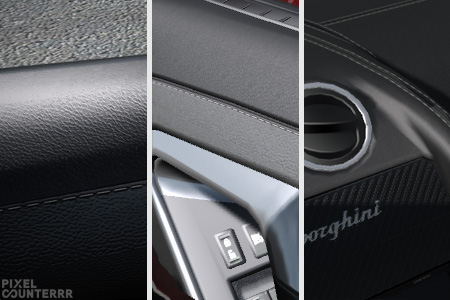
Look at all the detailing on the NfS:Shift’s dashboards. You can almost feel the stitching on the leather only by looking at it. Total craftsmanship.

It’s pretty safe to say that NfS:Shift was obviously designed from the ground up to be experienced through the gorgeously modeled interiors. So, this got me thinking, why there’s a third-person view at all in such game? Ok, I’m all for options, but in some cases developer should own a pair and make a design decision to exclude something which undermines the game’s premise. And let’s face it, when playing NfS:Shift from the third-person view, it just becomes another arcadey driving simulation, nothing more, nothing less.

And not even particularly good one.

There’s Something About Machinima

June 22, 2010

I remember back in 1994, or was it 1995, when I first saw SEGA’s Virtua Fighter 2 at the local arcade thinking: “Ok, this kind of visual fidelity would be more than enough to make movies with”, and my imagination started running wild of the possibilities. VF 2 wasn’t the first one with real-time texture mapping, but that technology combined with cinematic camera-movements, motion capture and fairly high poly-count was unprecedented at the time.

So, it was only the matter of time when the vision I had then came to existence in a form known as machinima. In short, machinima is a cinematic narrative realized by using some particular game engine and, usually, its in-game art assets as they are. The historical machinima milestone was reached recently when FOX aired a 30 min. machinima made by Rockstar Games using their own game Red Dead Redemption. To be honest, I found it booring as hell, but as a concept it was a cool move by FOX and Rockstar Games.

However, there’s an interesting ambivalence present in machinima. On the one hand, it can be seen as a tribute or celebration to the medium itself, as a “hey mom (cinema), look what I can do” –moment. But at the same time, it’s abusing the medium by not allowing user input to the process, which gives rise to the question why have it in real-time if there’s no genuine need for it? Obviously, the answer to that is, because it can.

All in all, it’s sad how much real-time medium has always wanted to be more like cinema, than itself. There was a time, when “geez, that game looks like a movie” –sentiment could have been considered as a compliment, but that time is long gone now and people should realize that the real-time medium is a whole different animal in itself.

The Problem Is Choice

May 26, 2010

Every game has this sweet spot in which the graphics engine performs and presents itself optimally on the screen. Obviously, those are the very same spots from where the screenshots for marketing are taken.

The thing is, the more freedom the player is given to, the smaller the sweet spot becomes, relatively speaking. At the dawn of the video games, one actually couldn’t take a bad screenshot of the game, since practically all the screenshots were “good”. Games back then just looked pretty much the same in all possible situations, like Pong or Space Invaders, and that’s because of the lack of freedom player had in the game.

With freedom, comes not responsibility, but a choice. Player can choose to fly low in Tom Clancy’s HAWX and expose the weaknesses of the graphics engine, or otherwise act so that her dealings break the game. This freedom to choose is the weakness and the asset of the medium at the same time, the weakness being the impossibility to merge total freedom and storytelling, which is why we still have the archaic cut-scenes around.

So, it was the 3D –graphics that introduced this issue with freedom, because the latitude of the player became exponential in comparison to 2D –space in which the objects were always in fixed distance of the screen. The player could now wander off from the sweet spot to examine objects up close and to see the flaws and limitations the graphics engine posed. The situation is like getting up from a ghost train ride to see which material the coulisses are made of.

The absolute freedom given to people hardly ever leads to preferable situations, in video games as in real life. Today’s game designers have to take account more than ever, that people will exercise the freedom they are given to and take a closer look at what the designers have created, and (in worst case scenario) post the glitches and intentionally ugly screenshots online to diss the game or the system it’s on. And to take that freedom away with invisible walls, for instance, is like asking a verbal abuse and beating from the online community.

And who can live with oneself after that?